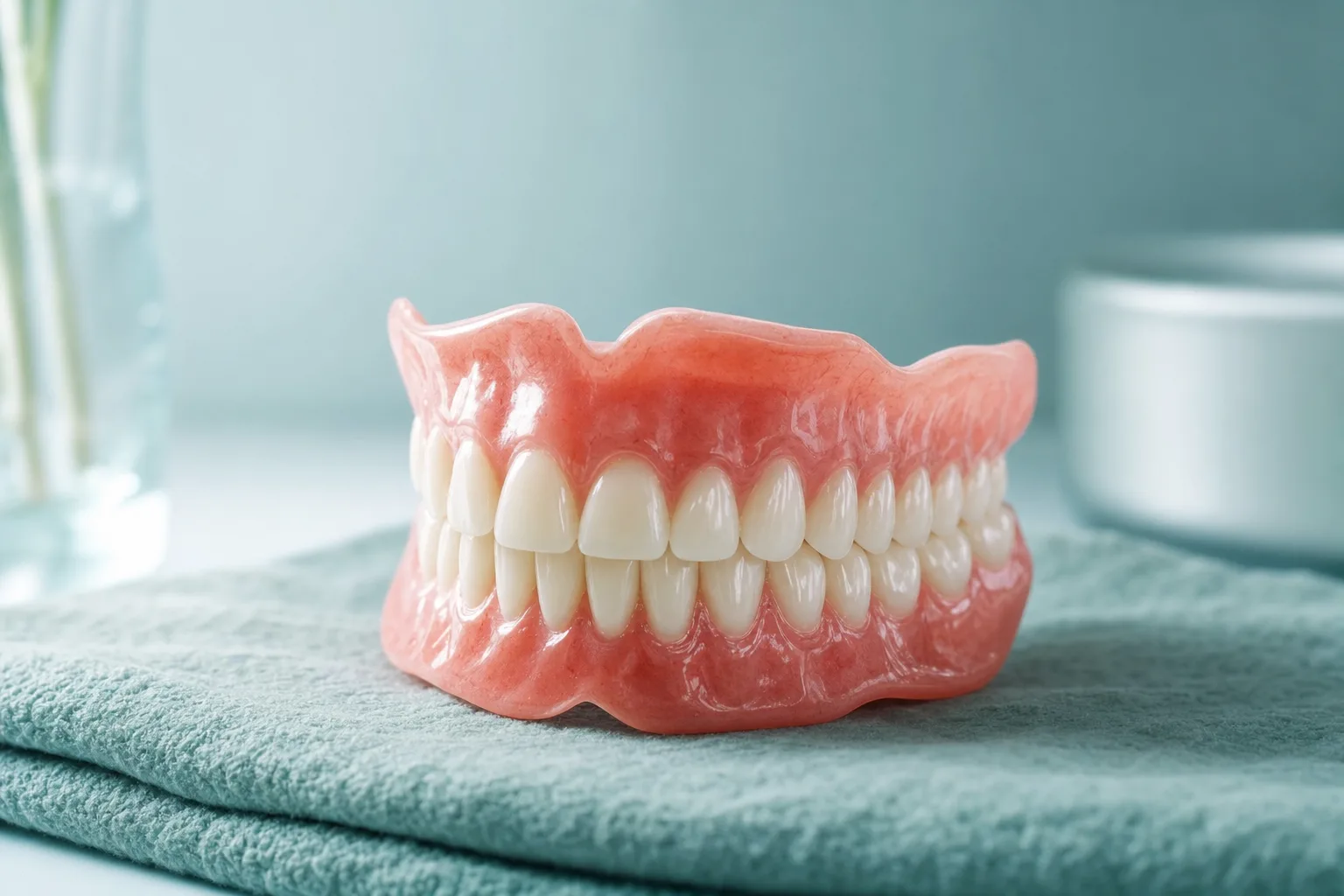
Dentures & Implants
What Drives the Cost of an Implant Overdenture in Los Angeles?
Two estimates for the same treatment can land $15,000 apart. Same jaw, same implant count, same county. That gap usually is not one office gouging and another being generous — it is six or seven variables folded into a single number that nobody broke out for you.
So here is the breakdown: what actually moves the price of a snap-in denture, which costs happen once, and which ones come back on a schedule.
What does an implant overdenture cost in the Los Angeles area?
Short answer: Third-party dental cost guides commonly place an implant overdenture in higher-cost metropolitan areas somewhere between roughly $7,000 and $30,000 per arch. That spread is genuine rather than sloppy reporting. Two implants under a lower denture sits near the bottom of it; four implants under an upper arch, with grafting and a new appliance, sits near the top.
Those are published third-party ranges for metro areas, quoted so you have a frame of reference. They are not Rio Hondo Dental's fees, and any single number you find online — ours or anyone else's — should be treated as a starting point rather than a quote. A price for this treatment only becomes meaningful once someone has looked at a scan of your jaw. What we can tell you about our own process is this: a removable overdenture retained by four implants begins with an exam and 3D imaging, and you leave with a written, itemized estimate that separates surgery, components and the appliance itself.
Published area ranges, component by component
Most cost pages hand you one figure for the whole arch. That is the least useful way to see it, because the whole-arch number is exactly where two quotes hide their differences. Broken into pieces, commonly published ranges look roughly like this.
| Component | Commonly published range (higher-cost metro areas) | What pushes it toward the high end |
|---|---|---|
| Exam, 3D cone-beam scan, planning | $150 – $500 | Whether a surgical guide is fabricated from the scan |
| Extraction of a remaining tooth | $150 – $650 each | Surgical rather than simple; broken roots; sedation |
| Bone graft at a single site | $400 – $1,200 | Graft material, membrane, number of sites |
| Sinus lift (upper back jaw) | $1,500 – $3,000+ | A lateral window rather than a lift through the implant site |
| One implant fixture, surgically placed | $1,500 – $3,000 | Implant system, bone quality, sedation, who performs the surgery |
| Attachment abutment per implant | $300 – $900 | Stud-style versus a milled bar spanning the implants |
| The overdenture itself, with housings | $1,500 – $4,000 per arch | Tooth grade, metal reinforcement, milled versus processed base |
| Two-implant lower overdenture, everything included | roughly $6,000 – $12,000 | Grafting, sedation, whether a new denture is in the number |
| Four-implant overdenture, everything included | roughly $12,000 – $30,000 | Upper arch, sinus work, bar attachment, opposing arch treatment |
Notice the arithmetic problem. Add the low end of every line and you get one total; add the high end and you get something close to four times larger. Neither total is wrong. Which end of each range lands on your plan is decided by the six factors below.
Six things that actually move the number
1. How many implants, and which jaw they go in
The lower front jaw has dense bone and no sinus above it, which is why two implants are often enough to retain a lower denture. The upper jaw is a different animal: softer bone, sinuses sitting over the back teeth, and a broader appliance to stabilize. Four implants is a common minimum for an upper overdenture, and sometimes more are planned.
Each added fixture brings its own abutment, its own attachment housing and more surgical time, so going from two to four rarely doubles the total but commonly adds several thousand dollars. It usually buys real function in return — better retention, less rocking, less load carried by each implant. This is the single largest fork in the estimate, and it is worth asking your dentist to price both versions rather than only the one they favor.
2. Whether you need grafting or sinus work
Jawbone shrinks once teeth are gone. The NIDCR and other public health sources describe ridge resorption as an expected consequence of tooth loss, and the fastest loss happens in the first year after extraction. Someone who has worn a full denture for fifteen years frequently has a ridge too thin or too short to place fixtures into without adding volume first.
That is where bone grafting enters the estimate — often a few hundred dollars per site, occasionally thousands if a sinus lift is required in the upper back jaw. Grafting also adds calendar time, commonly three to six months of healing before implants go in, which matters if you were hoping to be finished by a particular date. The cheapest version of this problem is preventing it: grafting a socket at the time of extraction usually costs a fraction of rebuilding a collapsed ridge years later.
3. Immediate versus delayed — how many appliances you are paying for
This is the quiet line item behind a surprising number of quote gaps. If teeth are being removed, you need something to wear while the ridge heals. That interim appliance is real work with a real lab bill. Three to six months later, once swelling and bone remodeling have settled, it either gets relined to fit the changed ridge or gets replaced by the definitive one.
Some quotes include both appliances. Some include only the final one and mention the interim denture later, as an add-on, after you have already committed. That difference alone can be $1,000 to $2,500. Ask which appliances the number covers, and how many you will actually own by the end.
4. The attachment system
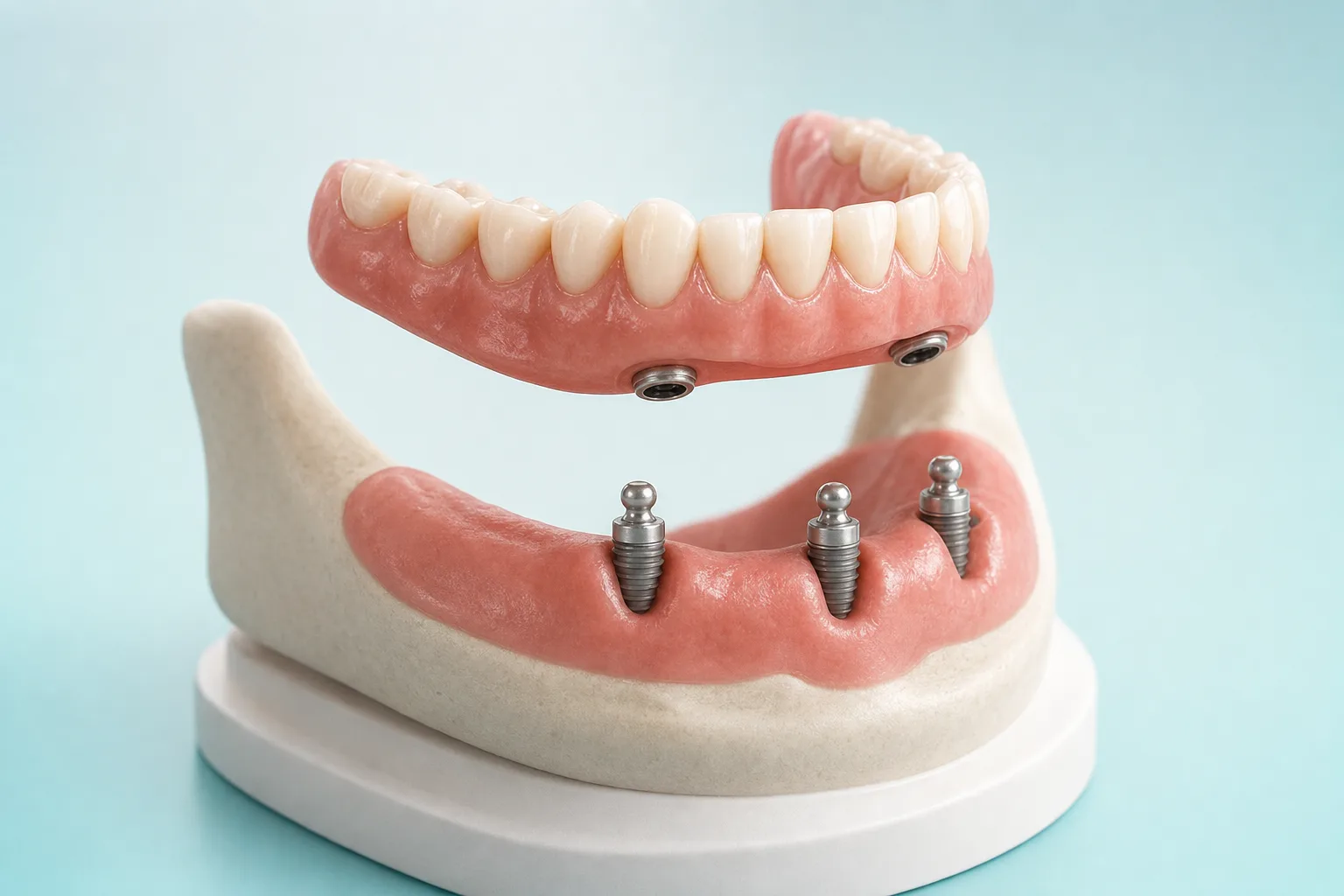
Two broad designs snap a denture onto implants. Stud-style attachments — the small individual connectors most people picture — sit on each implant and grip a nylon insert seated in the denture. A bar attachment instead splints the implants together with a custom-milled framework that the denture clips onto.
Bars cost meaningfully more up front because they are milled to your case, and they cost more to repair. They earn that money in specific situations: implants that are not parallel to one another, an upper arch needing maximum stability, a patient with heavy bite force. For a straightforward lower arch, stud attachments are usually simpler, cheaper and easier to service. If the estimate in your hand includes a bar, ask what about your case requires one.
5. What the arch bites against
Almost nobody explains this one, and it changes both cost and long-term outcome. An overdenture chewing against a full upper denture is under modest load. The same overdenture chewing against natural lower teeth, or against a fixed bridge, absorbs far more force — and that force lands on your implants, your attachments and your denture teeth.
A heavily loaded arch may need more implants, stronger retention, metal reinforcement in the acrylic and more frequent insert changes. It may also mean the opposing jaw needs treatment first. If nobody examined your other arch before quoting, the estimate is incomplete.
6. Lab and processing choices
Denture teeth come in grades, and the difference between an economy tooth and a high-wear layered tooth shows up both on the invoice and in how the appliance looks after five years. The base can be conventionally processed acrylic or milled from a solid puck; milled bases tend to be denser and more fracture-resistant, and they cost more.
Then there is reinforcement. Acrylic tends to crack around the attachment housings, because that is where the appliance is thinnest and most stressed. A cast metal framework embedded in the denture reduces that risk and adds cost. On an upper overdenture especially, this is money most patients would rather spend once than pay out again in repairs.
One-time costs versus costs that come back
Every published price you will find describes the first category and stays quiet about the second. Both are part of what this treatment costs you.
Paid once, or close to it:
- Consultation, 3D scan and treatment planning
- Extractions and any sedation
- Bone grafting or sinus augmentation
- The implant fixtures and their surgical placement
- Abutments, attachment housings or a milled bar
- The interim appliance worn during healing
- The definitive overdenture
Comes back on a schedule:
- Nylon retention inserts. These wear out, and that is their job — they take the abuse so the implant does not. Published figures for insert replacement are modest, commonly in the tens of dollars per insert plus the visit, but many patients need them changed somewhere between every six months and every couple of years depending on how often the denture goes in and out.
- Relines. The ridge underneath keeps changing shape for as long as you have the appliance. A lab reline is commonly published in the low hundreds of dollars and is typically needed every one to three years. Skipping it is not neutral: a base that no longer fits transfers load onto the attachments and accelerates every other problem. Our page on denture repairs and relines covers what that appointment involves.
- Appliance replacement. Denture teeth wear flat. Acrylic discolors and fatigues. Most overdentures are eventually remade, commonly somewhere in the five-to-ten-year range, and that is a genuine future expense worth planning for now.
- Maintenance visits. Implants need professional cleaning and periodic radiographs the same way teeth do. Keeping implants healthy long term is mostly a hygiene story, and it is far cheaper than treating disease around an implant after the fact.
Why two quotes for the same treatment differ so much
Once you know the variables, the differences stop looking mysterious. A quote can be lower because it genuinely is a leaner plan — fewer implants, no grafting, stud attachments — or because it left out something you will pay for anyway. Both happen, and you cannot tell which from the total alone.
Take the estimate you have and ask, item by item:
- How many implants is this number for, and what would the alternative count cost?
- Does this include the denture, or only the surgery? This is the most common gap of all.
- Does it include the temporary appliance I wear while healing?
- Is grafting included, or is it a contingency added if thin bone turns up during surgery? Get that contingency priced in writing now, not later.
- Which attachment system, and what does a replacement insert cost at your office?
- What is the first reline likely to cost, and when do you expect it?
- Does anything need to happen to my opposing arch first?
- How many appointments, over how many months?
An office that answers all eight without hesitating is quoting from a plan. One that cannot is quoting from a price list.
Denti-Cal, dental insurance and financing
There is a split here that almost nobody explains, and it changes the out-of-pocket math substantially.
Medi-Cal Dental adult benefits have commonly included complete dentures, subject to frequency limits and prior authorization. Dental implants have generally not been a routine adult benefit, and where a narrow exception exists it runs through prior authorization against specific criteria. In practical terms, that can mean the removable appliance is a covered benefit while the implants underneath it are self-pay. Program rules do change, so confirm current specifics before you build a plan around them. We accept Denti-Cal and Medi-Cal — our Denti-Cal and Medi-Cal page explains how that works here, and the detail of what adult Denti-Cal benefits actually cover is worth reading before your consultation.
PPO plans bring a different constraint: the annual maximum. Many plans cap yearly benefits somewhere around $1,000 to $2,000, which one arch of this treatment consumes immediately. Some plans classify the denture under major prosthodontics at partial coinsurance while excluding implants outright; others cover implants after a waiting period. Two practical moves help. Request a pre-treatment estimate in writing from your carrier before anything starts, and ask whether treatment can be sequenced across two benefit years — surgery in one, the appliance in the next.
For whatever remains, we work with CareCredit, Cherry and Sunbit, and our in-house membership plan covers routine care for patients without insurance. If you are still weighing this against other approaches, our comparison of implants versus conventional dentures lays out the trade-offs side by side.
Get seen urgently if… an implant or its attachment feels loose or moves, the gum around an implant is swollen, bleeding or draining, you develop numbness or tingling in the lip or chin after surgery, or a denture sore has not healed in two weeks. A loose implant is not something to monitor at home — early treatment sometimes saves the fixture, and waiting rarely does. Spreading facial swelling with fever, or trouble swallowing or breathing, belongs in an emergency room now.
What can disqualify you, or delay you
Cost is not the only gate. A consultation can end with "not yet" or "not this way," and the honest reasons include:
- Not enough bone in the right places. In the lower jaw, the nerve running through the mandible sets a hard limit. In the upper back jaw, the sinus does. Grafting solves many of these cases. It does not solve all of them.
- Uncontrolled diabetes. Poorly controlled blood sugar impairs healing and raises the risk of implant failure. Well-controlled diabetes is generally not a barrier.
- Smoking. Smokers have measurably higher implant failure rates. No dentist can promise you an outcome either way, but this is the one risk factor you can change before surgery rather than after.
- Active gum disease. Bacteria that destroyed bone around teeth will do the same around implants. Periodontal treatment comes first, and it belongs in the budget.
- Certain medications and past treatment. Intravenous antiresorptive drugs and prior radiation to the head and neck raise the risk of jaw healing complications. Bring your full medication list, including anything given by infusion.
There is also an expectation mismatch worth naming plainly. An overdenture is removable. It snaps in for the day and comes out at night for cleaning, and it will always feel like an appliance rather than like natural teeth — far more stable than a conventional denture, but not fixed in place. Some patients hear "implants" and picture teeth that never leave the mouth. If that is what you are imagining, say so at the consultation so the conversation starts in the right place. The American Dental Association's patient library at MouthHealthy is a reasonable neutral place to read about denture options first.
What waiting actually costs
Delay is a legitimate financial decision, and plenty of people need to make it. Just understand what changes while you wait. The ridge keeps resorbing, fastest in the early years after tooth loss, so a case that needs no grafting today may need it in three years. Remaining teeth carrying the load of a partial denture tend to fail one after another rather than all at once. And a conventional denture worn over a shrinking ridge loosens on a predictable schedule, requiring relines that are not free either.
None of that makes waiting wrong. It does mean the comparison is not "spend now versus spend nothing." It is "spend now versus spend later on a more complicated version of the same problem."
Get a number that belongs to your jaw
The only estimate worth acting on is one built from your own imaging, with every line written down. Dr. Sameer Aljanedi will examine you, explain which of these six variables apply to your case, and put an itemized plan in your hands before anything is scheduled. Our Downey team is bilingual and se habla español — book a consultation or call (562) 928-5559.
Have questions about your smile?
Dr. Sameer Aljanedi and the team at Rio Hondo Dental Office are here to help. Se habla español.