Preventive Care
Gum Disease Stages: What's Reversible and What Isn't
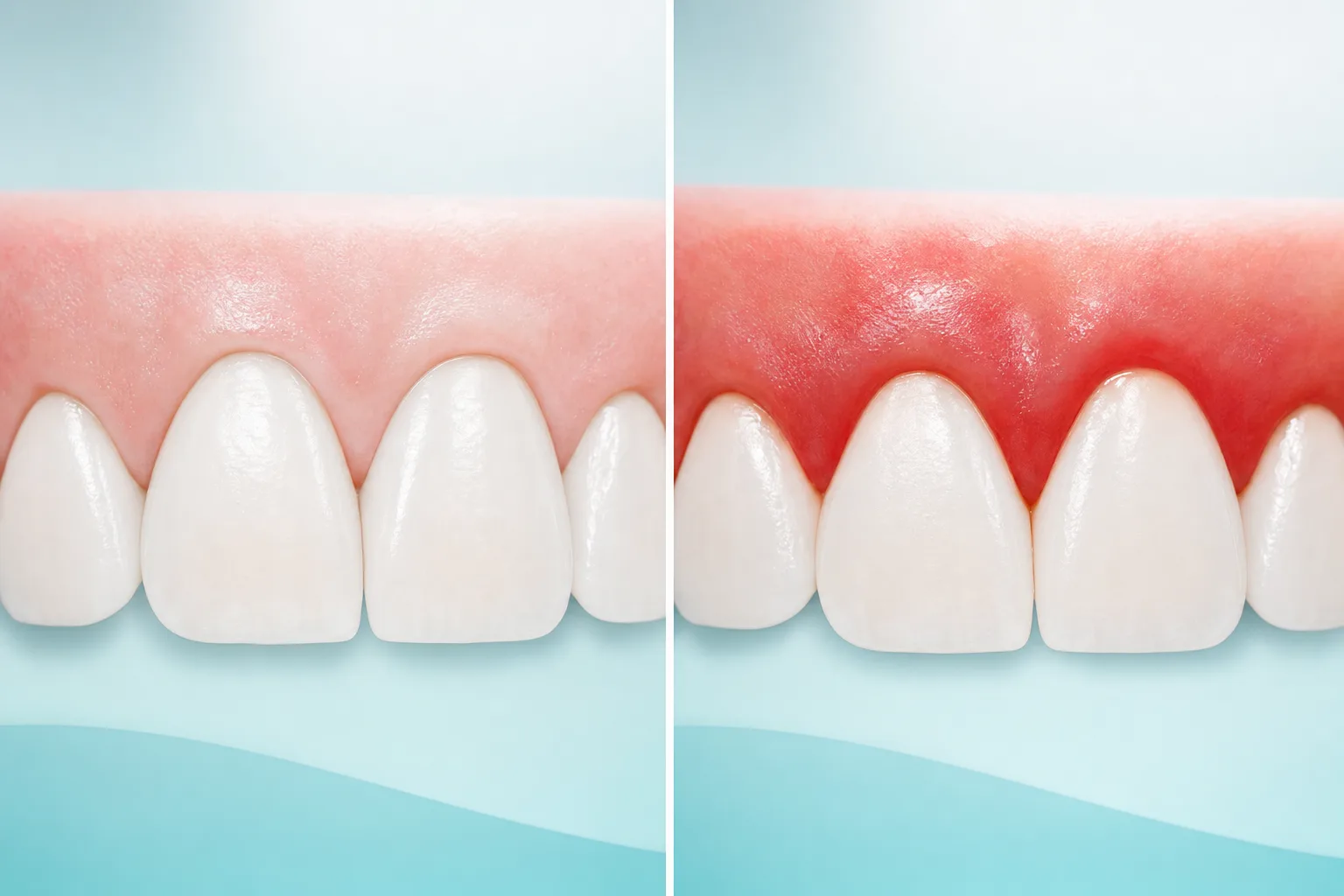
Gingivitis reverses. Periodontitis does not. Nearly everything patients want to know about gum disease follows from that one distinction, and most pages online will not say it that plainly.
Can gum disease be reversed?
Short answer: Gingivitis — inflammation confined to the gum tissue — is fully reversible, often within two to four weeks of a thorough cleaning and consistent brushing and flossing. Once the disease reaches the bone and becomes periodontitis, the bone that has already dissolved does not grow back on its own. Treatment from that point aims to halt the loss and hold what is left.
The dividing line is bone, not bleeding. Bleeding gums tell you inflammation is present; they do not tell you whether anything structural has been lost. That answer comes from two things: the depths measured around each tooth, and what the X-rays show about the bone level. Our page on periodontal therapy covers what treatment looks like once the diagnosis is made. This article is about how the diagnosis gets made in the first place, and which stage still has a way back.
It is a common problem, not a rare one. Federal surveillance data reported by the CDC and the National Institute of Dental and Craniofacial Research puts periodontitis in roughly four out of ten adults aged 30 and older, with the share climbing steeply after 65. Most of those people feel completely fine.
The stages of gum disease, and what each one can still be fixed
| Stage | What you would notice | Reversible? | Usual treatment |
|---|---|---|---|
| Healthy | Firm pink gums, no bleeding when you floss, no odor | — | Routine cleaning, typically every six months |
| Gingivitis | Red or puffy gum margins, bleeding when brushing or flossing, occasional bad breath | Yes — completely | Regular cleaning plus real home care; recheck in a few weeks |
| Early periodontitis | Usually nothing. Maybe slight bleeding. Pockets reach 4–5 mm | No — but it can be stopped here, and this is the best place to stop it | Scaling and root planing, then maintenance visits |
| Moderate periodontitis | Gums pulling back, teeth looking longer, sensitivity to cold at the roots, pockets 5–6 mm | No — damage is permanent; progression is controllable | Scaling and root planing, closer recall intervals, sometimes surgical access |
| Advanced periodontitis | Loose teeth, teeth drifting or gaps opening, abscesses, pockets 7 mm and deeper | No | Periodontal surgery, grafting in selected sites, extraction of hopeless teeth |
Two things about that table are worth sitting with. First, the stage where you would notice almost nothing is the stage where treatment works best. Early periodontitis is quiet by nature — there is no toothache, because bone has no nerve supply that reports its own disappearance. Second, "not reversible" is not the same as "not treatable." A mouth stabilized at 5 mm can stay at 5 mm for decades. The goal shifts from cure to control, and control is genuinely achievable.
What your pocket depth numbers actually mean
During a periodontal exam, a small calibrated probe is walked around each tooth and the depth of the gum cuff is recorded at six points per tooth. That is where the string of numbers you hear called out comes from — "three, two, three … four, five, four." Patients are measured against these numbers constantly and rarely shown them. Here is the scale.
| Reading | What it means | What typically follows |
|---|---|---|
| 1–3 mm, no bleeding | Healthy. A normal gum cuff you can clean at home | Routine cleaning schedule |
| 1–3 mm with bleeding | Gingivitis. Inflamed, but nothing lost yet | Cleaning, home-care coaching, recheck |
| 4 mm | The therapeutic threshold. Deeper than a toothbrush bristle or floss can reach | Depends on bleeding and bone level — may be localized |
| 5–6 mm | Moderate. Bacteria live below the reach of any home tool | Scaling and root planing, then three-month maintenance |
| 7 mm and above | Severe. Often with visible bone loss on X-ray | Deep cleaning plus surgical or specialist evaluation |
Why 4 mm keeps coming up: that is roughly where a toothbrush bristle and floss stop reaching. Below that depth the pocket becomes a sheltered, oxygen-poor space that favors the bacteria that damage bone. You cannot clean your way out of a 6 mm pocket at home, no matter how diligent you are, and being told otherwise sets you up to blame yourself for something mechanical.
The number that matters more than pocket depth
Pocket depth alone can mislead, and this is the part almost no patient hears. If the gum has receded, the pocket reading understates the damage. A tooth with a 3 mm pocket and 3 mm of recession has lost 6 mm of attachment — more than a tooth with a 5 mm pocket and no recession. Clinicians call the combined figure clinical attachment loss, and it is the truer measure of how much support a tooth has given up. If your gums have visibly receded, ask whether recession is being recorded alongside the pockets. Our guide to why gums recede and what can be done about it covers the causes that are not gum disease at all.
Bleeding on probing is the other half of the picture. A 4 mm pocket that does not bleed is far less concerning than a 4 mm pocket that bleeds every time. Bleeding indicates the disease is currently active rather than historic — and if you are seeing blood at home, our piece on gums that bleed in the morning is worth a read.
Does bone grow back once it is gone?
In general, no. Bone lost to periodontitis does not spontaneously refill once inflammation is controlled. The pocket may tighten by a millimeter or two as swollen tissue shrinks and the gum reattaches to a cleaned root surface, which is a real gain — but that is tissue tone, not new bone.
There is a narrow exception worth knowing about. Certain bone defects, particularly deep narrow craters with walls remaining on several sides, can respond to regenerative procedures using grafting material or biologic membranes, and some bone fill is achievable in those specific sites. Broad, flat, horizontal bone loss — the more common pattern — does not regenerate that way. Anyone promising to regrow your jawbone across the board is overselling. Ask which defect shape you have, and expect a specific answer.
"Do I really need a deep cleaning, or is this an upsell?"
Patients ask this often, usually apologetically. It deserves a straight answer rather than a defensive one, because a scaling and root planing appointment costs meaningfully more than a routine visit and commits you to a different schedule afterward.
A legitimate deep-cleaning recommendation rests on documented findings, not on a general impression that your gums look irritated. There should be:
- A full periodontal chart — six measurements per tooth, written down, with bleeding points marked.
- Pockets of 4 mm or greater in the areas being treated, not just one isolated reading.
- Bone loss visible on X-rays, usually bitewings or periapicals, corroborating the probe readings.
- A specific scope: which quadrants, and how many teeth in each. Scaling and root planing is billed by quadrant, and the code differs for one to three teeth versus four or more.
If your pockets are 1–3 mm, nothing is bleeding, and the bone levels look normal on film, a deep cleaning is not indicated — a standard preventive cleaning is. It is entirely reasonable to say: show me the chart and show me the bone loss on the X-ray. Any office practicing honestly will pull it up on the screen. The American Dental Association's patient library describes the same diagnostic basis.
The reverse mistake is also common and does more harm: being given a routine polish year after year while pockets quietly deepen, because nobody probed. If it has been years since anyone called out numbers around your teeth, that is the gap to close.
The cost consequence nobody mentions up front
Here is the part that surprises people months later. After scaling and root planing, you generally do not go back to regular cleanings. You move to periodontal maintenance, typically every three to four months rather than every six, and for most patients that continues indefinitely. Periodontitis is managed like a chronic condition, not cured like a cavity.
That has a budget consequence. Many dental plans cover two routine cleanings per calendar year. A three-month maintenance interval means four visits, so one or two may fall outside what the plan pays. Some PPO plans do allow four periodontal maintenance visits annually, or will alternate them with covered cleanings — the language varies by contract, and it is a specific question worth asking your carrier before you start, not after. Adult benefits under Medi-Cal Dental have their own frequency limits; our Denti-Cal and Medi-Cal information outlines what we accept, and benefit rules do change, so confirm current details with our front desk.
None of this is an argument against treatment. It is an argument for knowing the real shape of the commitment before you say yes, so the third visit of the year does not arrive as an unpleasant surprise.
What happens if you do nothing
Untreated periodontitis rarely announces itself. It does not progress on a steady schedule either — it tends to move in bursts, with quiet stretches between them, which is exactly why people conclude it went away. A rough sense of the arc:
- Months one through twelve. Pockets deepen a millimeter here and there. Bleeding may come and go. Bad breath becomes persistent. Nothing hurts.
- Year two to year five. Recession becomes visible. Roots are exposed and turn sensitive to cold and to sweets. Food starts packing between specific teeth in a way it never used to. Root-surface decay becomes a real risk.
- Beyond that. Teeth loosen as support falls away. Front teeth may flare or drift, and gaps open where there were none. Acute abscesses become likely. At this point some teeth are no longer savable, and extraction enters the conversation.
There is a compounding problem people rarely anticipate. Bone lost to gum disease is the same bone that would later anchor an implant or support a denture. Waiting does not just cost you teeth — it can cost you the straightforward version of replacing them, turning a simple plan into one that requires grafting first. The cheapest moment to deal with gum disease is always the earliest one you are offered.
Get seen urgently if… a gum area is swollen and painful, a pimple-like bump appears on the gum and drains a bad taste, a tooth has become noticeably loose over days rather than years, or you have a bad taste with fever. Facial swelling that is spreading — especially with fever, difficulty swallowing, or trouble breathing — is an emergency room visit right now, not a dental appointment next week.
What speeds gum disease up
Two people with identical home care can end up in very different places, and the reasons are mostly not about effort.
- Smoking and vaping. The single strongest modifiable risk factor. Nicotine constricts the small vessels in the gums, which masks bleeding — so smokers often look healthier than they are while losing bone faster, and they respond less predictably to treatment.
- Diabetes, particularly when poorly controlled. The relationship runs both ways: high blood sugar worsens periodontal inflammation, and periodontal inflammation makes glucose harder to control.
- Genetics. Some patients inherit a more aggressive inflammatory response. If a parent lost teeth to gum disease in their fifties, mention it — it changes how closely you should be monitored.
- Dry mouth. Saliva is the mouth's rinse cycle. Blood pressure medications, antidepressants, antihistamines and diuretics commonly reduce it.
- Pregnancy and hormonal shifts. Hormonal changes exaggerate the gum response to the same amount of plaque.
- Clenching and grinding. Grinding does not cause periodontitis, but on a tooth that has already lost support it accelerates loosening.
Five questions to ask at your next visit
- What are my deepest pocket readings, and how many teeth are involved? A number and a count. "Your gums look a little inflamed" is not a diagnosis.
- Am I bleeding on probing, and where? This is what separates active disease from a stable history.
- Can you show me the bone level on my X-rays? Bone loss is visible once someone points at it.
- Has anything changed since my last chart? Comparison across visits tells you whether you are stable or sliding.
- If I have this treated, what does my schedule look like for the next two years? This surfaces the maintenance interval and the coverage question before you commit.
Find out which stage you are actually in
If nobody has probed your gums and shown you the numbers recently, you do not yet know whether you are in the stage that reverses or the stage that only gets held steady. Dr. Sameer Aljanedi and our bilingual team in Downey will chart it, show you the readings and the X-rays, and tell you honestly which one it is — se habla español. Book an exam or call (562) 928-5559.
Have questions about your smile?
Dr. Sameer Aljanedi and the team at Rio Hondo Dental Office are here to help. Se habla español.