Preventive Care
How Often Do You Really Need a Dental Cleaning?
Twice a year is a convention. It is a sensible one for many mouths, but nobody ever proved that six months is the correct gap for every adult. Plenty of people are on the wrong schedule in both directions: some come in more often than their teeth require, and others — usually the ones with gum disease — are not coming in nearly often enough.
So if you have wondered whether the six-month rule is a sales habit, or you were just told to come back in three months and it sounded like an upsell, here is how the interval really gets decided.
How often should you get your teeth cleaned?
Short answer: Most healthy adults do well with a professional cleaning every six months, but that figure is a default, not a rule. Risk sets the real interval. A history of gum disease, diabetes, smoking, dry mouth, braces or implants often means every three to four months, while a few genuinely low-risk adults can stretch toward nine to twelve.
A professional cleaning and exam does two separate jobs. The cleaning removes tartar, which is plaque that has hardened onto the tooth and no longer comes off with a brush. The exam looks for things you cannot feel yet: a cavity starting between two teeth, a leaking filling, gums quietly detaching from a root. Neither job runs on the calendar. Both depend on how fast you build tartar, how your gums react to it, and how quickly problems tend to develop in your particular mouth.
Is every six months evidence-based, or just tradition?
Mostly tradition. The twice-a-year advice was in circulation for decades before anyone tested it properly.
When researchers finally compared a fixed six-month schedule against one tailored to each patient's risk, the larger reviews found little or no difference in cavities or gum health over several years. One catch: those studies mostly enrolled adults who were healthy to begin with. People with significant gum disease were not the ones being studied, and that is the group where frequency clearly matters. The American Dental Association lands in the same place — how often you are seen should be set by your dentist according to your own health and history, not by the calendar.
Six months survives for practical reasons, and they are not bad ones. It is easy to remember. Insurance plans are built around it. Plaque you miss can begin hardening into tartar within days, and most adults rebuild a noticeable amount in half a year. A cavity caught at six months is usually a small filling.
Treat it as a reasonable starting point for someone whose risk has not been measured. Once it has been measured, the measurement should win.
Cleaning intervals by risk level
This is roughly how dentists sort patients. If you fit more than one row, the shorter interval applies.
| Your situation | Typical interval | Why |
|---|---|---|
| Low risk — no cavities in years, gums that do not bleed when measured, no bone loss, non-smoker | Every 6 months; some can extend to 9–12 with their dentist's agreement | Slow tartar buildup and nothing active to monitor |
| Moderate risk — a cavity in the last couple of years, gums that bleed (gingivitis), heavy tartar, many fillings or crowns | Every 6 months, sometimes every 4 | Gingivitis reverses when plaque is removed on schedule; the edges of old dental work trap bacteria |
| History of gum disease — periodontitis, usually treated with a deep cleaning | Every 3–4 months (periodontal maintenance) | Bacteria in deep pockets rebound in about three months and home care cannot reach them |
| Diabetes, smoking or vaping, dry mouth from medications or medical treatment | Often every 3–4 months, at least until things are stable | Diabetes and gum infection aggravate each other; nicotine hides bleeding; low saliva lets decay move fast |
| Braces, implants, bridges | Every 3–6 months | Hardware collects plaque, and an implant can lose supporting bone without hurting |
| Pregnancy | Keep the regular visit; add one if gums swell or bleed | Hormonal changes make gums react more strongly to plaque |
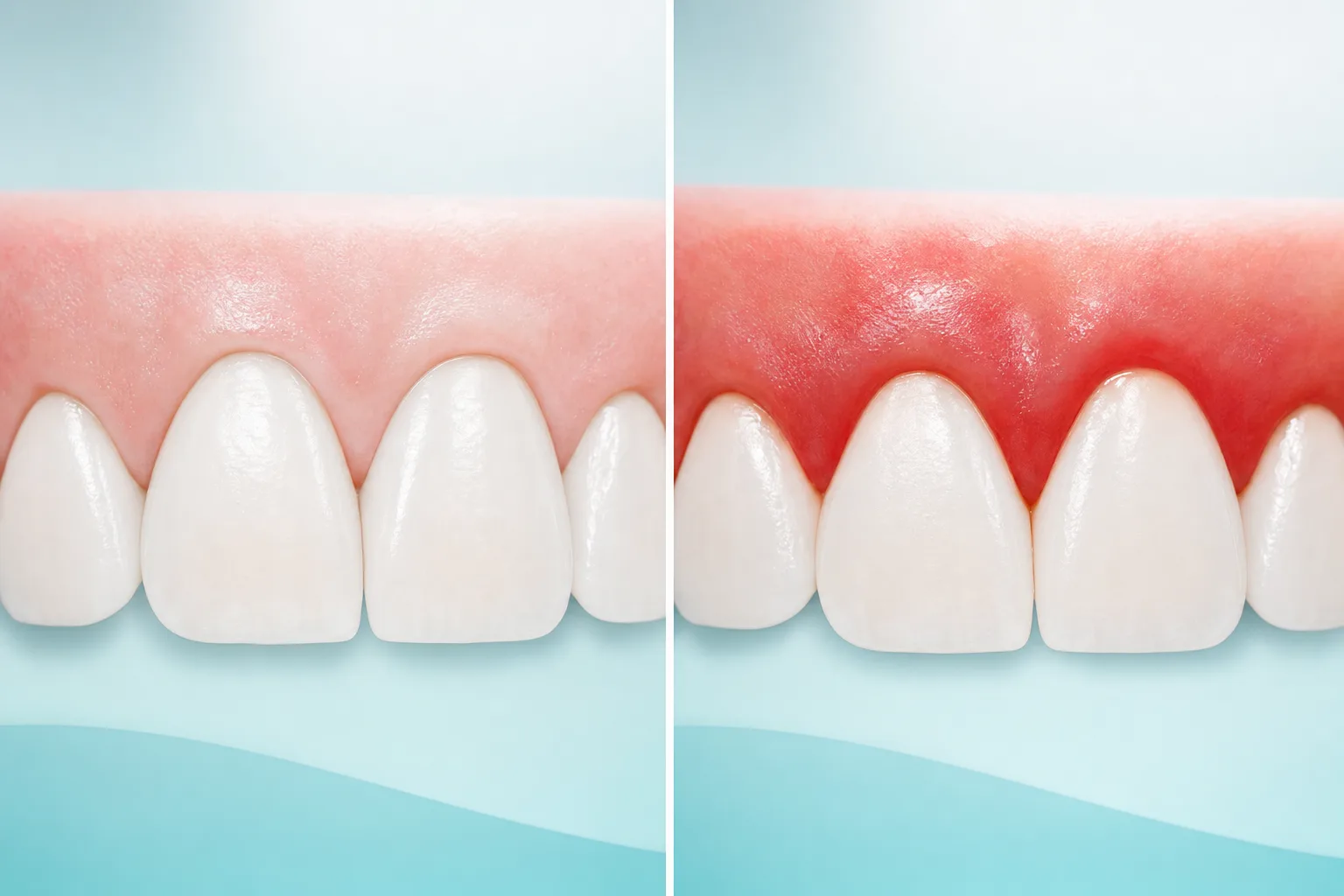
None of these categories is a guess. A thin probe measures the space between gum and tooth at six points around every tooth. One to three millimeters with no bleeding is healthy. Four or more, particularly with bleeding, suggests the gum is pulling away from the root. Add X-rays that show bone height, your cavity history and how much tartar has come back since the last visit, and the interval more or less picks itself.
Ask for your numbers. They are yours.
Who needs a cleaning every three or four months, and why?
Mainly people who have had periodontitis — the stage of gum disease where the bone holding the teeth has started to dissolve. Gingivitis, the earlier stage, heals completely. Bone loss does not grow back. If you are unsure which side of that line you are on, our guide to which stages of gum disease are reversible lays it out.
Active periodontitis is usually treated first with scaling and root planing, the procedure most people call a deep cleaning. That calms the infection. It does not cure the tendency. The bacteria responsible live under the gumline in pockets too deep for floss or bristles, and after a thorough cleaning they generally rebuild to harmful levels in about three months. A three-month visit breaks that cycle before the next round of damage begins. A six-month visit arrives after it.
That is the whole reason. It is not a punishment for flossing badly, and it is not permanent in every case. When pockets stay shallow, nothing bleeds and the bone holds steady for a year or two, it is fair to ask whether four months would be safe. Going all the way back to six is less common once bone has been lost, because the relapse is silent and the cost of being wrong is a tooth.
Routine cleaning vs. periodontal maintenance: why the bill looks different
Patients notice this at the front desk. The three-month visit carries a different name, a different fee and different insurance treatment from the cleaning they used to get. These really are two procedures.
- A routine cleaning (prophylaxis) is preventive care for a mouth without bone loss. Tartar and stain come off at and just under the gumline, the teeth are polished, and you are done.
- Periodontal maintenance is continuing treatment for gum disease. The pockets get re-measured, the roots are cleaned below the gumline, and any site that has flared up is treated on the spot. It takes more time and more skill.
Insurers file the first under preventive benefits and the second under periodontal or basic services, which often means a copay where the routine cleaning had none. Some plans also count both against the same yearly limit. One blunt point: the procedure billed has to match the diagnosis and the work performed. An office cannot relabel maintenance as a regular cleaning to get it covered, and you should be wary of anyone who offers to.
Who can reasonably go longer than six months?
Fewer people than would like to, but the group is real. You are a candidate if all of the following hold:
- No new cavities for at least three to five years
- No pockets deeper than 3 mm and no bleeding when your gums are measured
- No bone loss on your X-rays
- You do not smoke or vape, you do not have diabetes, and you take no medications that dry your mouth
- You brush twice a day with fluoride toothpaste and clean between your teeth daily
- Little or no dental work — crowns, bridges and implants all need closer watching
The honest problem with deciding this yourself is that early decay and gum disease do not hurt. "My teeth feel fine" describes most people with a 5 mm pocket. So the longer interval should come out of an exam, not replace one.
Money matters here too. If your plan pays in full for two visits a year, skipping one saves you nothing. If you pay out of pocket and you are truly low risk, asking about a nine-month schedule is a reasonable conversation, and a good dentist will have it without getting defensive.
What does insurance usually pay for?
General patterns only, because every plan writes its own rules:
- PPO and HMO plans commonly cover two cleanings and exams a year at or near full cost. Read the wording. "Two per calendar year" is flexible. "One every six months" can mean a claim is denied because you came in a few days early.
- Extra cleanings. Some plans allow a third or fourth visit for members who are pregnant, diabetic or have a history of gum disease. Almost nobody asks.
- Periodontal maintenance is frequently paid at a lower percentage than a routine cleaning, with anywhere from two to four visits a year allowed.
- Denti-Cal and Medi-Cal cover exams and cleanings for adults, with frequency limits of their own that can be tighter than a private plan's. Deep cleaning and the maintenance that follows generally require documented gum disease and may need approval in advance. The state revises these rules, so ask us to check your eligibility and current limits before the visit. Our Denti-Cal coverage guide has more detail.
- No insurance. Our in-house membership plan includes routine cleanings, which makes the cost of staying on schedule predictable.
A timing note for this point in the year: most plans reset on January 1, and an unused cleaning does not roll over. If you have been in only once in 2026, there is still room for a second visit before December schedules fill up.
What actually happens if you skip a year?
It depends on which row of the table you are in.
Low risk: probably not much. More tartar, a longer appointment with more scraping, gums that are puffy and bleed a little for a few days afterward. Most of that resets. The real exposure is the exam you missed. A cavity between two teeth that would have been a small filling has had twelve more months to grow, and decay does not send a warning until it nears the nerve.
Moderate risk: this is where gingivitis has time to cross into periodontitis. You will not feel the transition. You find out when the probe reads 5 where it used to read 3.
Gum disease history: a missed year can undo what the deep cleaning achieved. Pockets deepen again, more bone goes, and the treatment may need repeating — while many insurance plans limit how soon they will pay for it a second time. Diabetes raises the stakes further: the National Institute of Dental and Craniofacial Research lists it among the main risk factors for gum disease, and ongoing gum infection can in turn make blood sugar harder to manage.
We have written separately about what skipped cleanings end up costing once small problems turn into large ones.
If it has been several years, expect the first visit to be an exam, X-rays and gum measurements before anyone decides which kind of cleaning you need. That order is correct. Polishing over an undiagnosed infection helps nobody. You will not get a lecture from us either; a long gap is common and it is fixable.
Signs you should not wait for your next scheduled cleaning
- Gums that still bleed most days after two weeks of careful brushing and flossing
- Bad breath or a bad taste that keeps returning
- Gums pulling back, or teeth that look longer than they used to
- A tooth that feels loose, or a bite that has shifted
- Lingering sensitivity to cold or sweets in one spot
- A sore or patch in your mouth that has not healed in two weeks, which warrants an oral cancer screening
Get seen urgently if you have swelling in the gum, face or jaw, pus near a tooth, or tooth pain with a fever. That is an infection, not a cleaning issue. Call (562) 928-5559 during office hours or see our dental emergency page. If swelling is spreading or you have trouble breathing or swallowing, go to an emergency room.
Questions to ask at your next visit
- What were my deepest pocket readings, and how many sites bled?
- Is today a routine cleaning or periodontal maintenance, and which finding puts me there?
- What is my cavity risk, and what is driving it?
- What would need to change for you to lengthen my interval — or shorten it?
- What does my plan cover at this frequency, and what will I owe if it does not?
A dentist who recommends three months should be able to show you the pocket chart and X-rays behind that recommendation. If they can, take it seriously. If they cannot, ask again.
Find out which interval fits your mouth
If you are not sure which row you belong in, that is what the exam is for. At Rio Hondo Dental in Downey, Dr. Sameer Aljanedi and our bilingual team will measure your gums, show you the numbers and recommend a schedule you are welcome to question — se habla español. Request a cleaning and exam or call (562) 928-5559.
Have questions about your smile?
Dr. Sameer Aljanedi and the team at Rio Hondo Dental Office are here to help. Se habla español.