Insurance & Costs
What Denti-Cal and Medi-Cal Actually Cover for Adults

Denti-Cal is not a separate program from Medi-Cal. It is the dental half of it, and for adults 21 and over it pays for more than most people expect — exams, X-rays, cleanings, fillings, extractions, dentures, root canals on the front teeth. What catches people out is the machinery underneath: an annual dollar limit, an approval step on anything expensive, and a short list of procedures that simply are not adult benefits.
The rules below are the working version we plan treatment around, current as of August 2026. Benefit criteria are set by the California Department of Health Care Services and published in its Manual of Criteria; the state's patient-facing site, Smile California, carries plain-language summaries and a member line. Both change, so verify anything you are about to build a decision on. If your question is simply whether a practice takes your card, that belongs on our Denti-Cal and Medi-Cal page rather than here.
What does Denti-Cal cover for adults?
Short answer: Medi-Cal Dental covers adults for exams, X-rays, a yearly cleaning, fillings, extractions, emergency pain relief, root canals on front and premolar teeth, and full or partial dentures. Crowns, dentures and deep cleanings usually require prior authorization first. Implants, whitening, veneers and most adult orthodontics are not benefits. An annual dollar limit applies to much of it.
That is the shape of it. The detail is where treatment decisions actually get made, so here is the whole board.
Adult Medi-Cal Dental benefits, procedure by procedure
Two columns are not enough for this program. A large share of adult treatment sits in the middle — a benefit, but only after the state reviews the documentation and agrees.
| Procedure | Adult status | What to know |
|---|---|---|
| Exam and X-rays | Covered | Frequency limits apply — commonly one periodic exam and bitewings per 12 months, a full series far less often |
| Routine cleaning | Covered | Generally once every 12 months for adults, not every six |
| Deep cleaning (scaling and root planing) | Usually prior authorization | Requires pocket charting and X-rays showing bone loss; quadrant limits apply |
| Fillings | Covered | Material may be restricted by tooth and surface |
| Extractions | Covered | Includes surgical extractions; emergency extractions are treated as urgent care |
| Emergency exam and pain relief | Covered | Does not wait on authorization, and is not gated by the annual limit |
| Root canal — front teeth and premolars | Covered | Some cases still route through authorization depending on the tooth and findings |
| Root canal — molars, age 21+ | Generally not a benefit | Exception pathway exists where extraction is medically contraindicated and documented |
| Prefabricated crown, back tooth | Covered | A preformed stainless steel cap, seated the same day — protective, and metallic |
| Lab-processed crown | Prior authorization, and restricted | Adult posterior lab crowns are limited; anterior cases are judged differently |
| Complete dentures | Prior authorization | Generally one set per five years; exceptions require documentation |
| Partial dentures | Prior authorization | Criteria consider how many teeth remain and where they sit in the arch |
| Denture reline, rebase, repair | Covered with limits | Own frequency rules, separate from the five-year replacement clock |
| Dental implants | Not a routine benefit | Approval only through narrow, heavily documented circumstances |
| Whitening, veneers, cosmetic work | Not covered | No exception pathway — these are elective by definition |
| Adult orthodontics | Generally not covered | Narrow medically necessary categories such as cleft palate are handled separately |
One thing that table cannot show you: frequency limits run on a rolling clock from the date of the last service, not from January. If a cleaning was done in November, the next covered one is the following November, regardless of what the calendar year is doing.
The adult annual limit, and what falls outside it
Adults 21 and over have an annual dollar maximum on most Medi-Cal Dental services — roughly $1,800 per benefit year. Three things about it are widely misunderstood, and all three matter.
It is not a cash allowance. The $1,800 is measured against the program's own allowed fees, which are well below what the same treatment is billed at privately. So it stretches considerably further than $1,800 of out-of-pocket money would.
It is a soft cap, not a wall. Care beyond the limit can still be authorized when it is medically necessary and the documentation supports it. That request goes through the same review process as any prior authorization, which means it takes time and it can be denied — but it exists, and plenty of patients never learn that.
Emergency care sits outside it. Treatment to relieve pain or address infection is not held hostage by the limit, and certain groups are exempt from the cap entirely — members under 21, pregnant members, and members in skilled nursing or intermediate care facilities among them.
Why sequencing matters more than the number
If a mouth needs a lot of work, the order it is done in decides how much of it gets done. Disease first: infection, decay that is actively spreading, gum treatment that stops bone loss. Then stabilization. Prosthetics — dentures, crowns — often land better in the next benefit year, because they are the expensive line items and they do not stop anything from getting worse while you wait.
A dentist who plans around the benefit year should be able to tell you which treatment is being done now, which is being deferred, and specifically why. If nobody has mapped that out, ask for it. It is the difference between finishing a treatment plan and abandoning it half-done in October.
Prior authorization: what it is and how long it takes
Prior authorization means your dentist submits the case to the program before treating and waits for a decision. The submission carries X-rays, charting, and a written narrative explaining why this treatment for this tooth. Reviewers compare it against the Manual of Criteria and approve, modify, or deny.
Two practical points nobody tells patients. First, a large share of denials come down to incomplete documentation rather than the treatment being wrong — a missing radiograph, charting that does not support the diagnosis, a narrative that never states the clinical reasoning. Those are frequently resubmitted successfully. Second, review takes weeks, not days. That is the real reason the crown you were told about in March gets seated in May, and it is worth knowing up front so the delay does not read as the office dragging its feet.
Emergency treatment does not queue behind any of this. If you are in pain or swollen, you get seen and treated.
Does Denti-Cal cover crowns for adults?
Yes — with a distinction that changes the conversation entirely.
On back teeth, the adult benefit is commonly met with a prefabricated crown: a preformed stainless steel cap, sized to the tooth and cemented the same day. It is legitimate treatment. It holds a broken-down molar together and stops the fracture that would otherwise cost you the tooth. It is also metallic, visible if you open wide, and fitted to the tooth rather than custom-milled for it, so the margin seal is generally not as precise as a laboratory crown's.
Laboratory-processed crowns — porcelain, custom-made — are more restricted for adults and run through prior authorization, with front teeth judged on different criteria than molars. If you want porcelain on a back tooth and the program will not cover it, that becomes an out-of-pocket upgrade rather than a covered benefit. Our page on dental crowns explains what the restoration does mechanically, which is the part that should drive the decision either way.
Does Medi-Cal cover root canals on back teeth?
This is the single rule that reshapes more adult treatment plans than any other, and almost nobody publishes it plainly.
Root canal therapy on front teeth and premolars is an adult benefit. Endodontic treatment on permanent molars for adults 21 and over is generally not a benefit, absent a documented medical contraindication to removing the tooth instead. So when a molar is abscessed, the covered path is usually extraction.
That means the choice many adults are actually facing is not "root canal or extraction" on clinical grounds alone. It is a covered extraction now, or a self-pay molar root canal plus the crown that has to follow it. Both are defensible. What is not defensible is choosing without knowing what the space does afterward.
A missing molar does not stay a tidy gap. The tooth above it drifts down into the space over months and years, neighbouring teeth tip toward it, the bite changes, and the ridge underneath resorbs. The American Dental Association's patient library covers the same ground in its material on missing teeth and replacement options. If you know honestly that you are not going to replace the tooth, say so out loud before the decision is made — it genuinely changes which option is better. Our overview of ways to replace a missing tooth lays out what comes next, and extraction covers the procedure itself.
How often can I get new dentures on Medi-Cal?
Complete dentures are a covered benefit with prior authorization, and the replacement frequency is generally one set per five years. Partials follow their own criteria based on how many teeth remain and where.
Inside that five-year window, replacement requires a documented exception. Loss in a fire or theft, or a ridge that has changed so substantially that no adjustment or reline can make the appliance fit, are the kinds of circumstances that get reviewed. "It never fit right" on its own usually does not clear the bar, which is why the fit conversation needs to happen during the delivery appointments rather than three years later.
What keeps the five-year rule survivable is the maintenance benefits underneath it. Relines, rebases and repairs carry their own frequency limits and are separate from the replacement clock. An immediate denture — one placed the day the teeth come out — will need relining as healing progresses, because the appliance does not shrink but the ridge does. That is expected, not a failure of the denture. More on that in our guide to denture relines and repairs, and the basics of the appliance itself on our dentures page.
The gap the program leaves on lower dentures
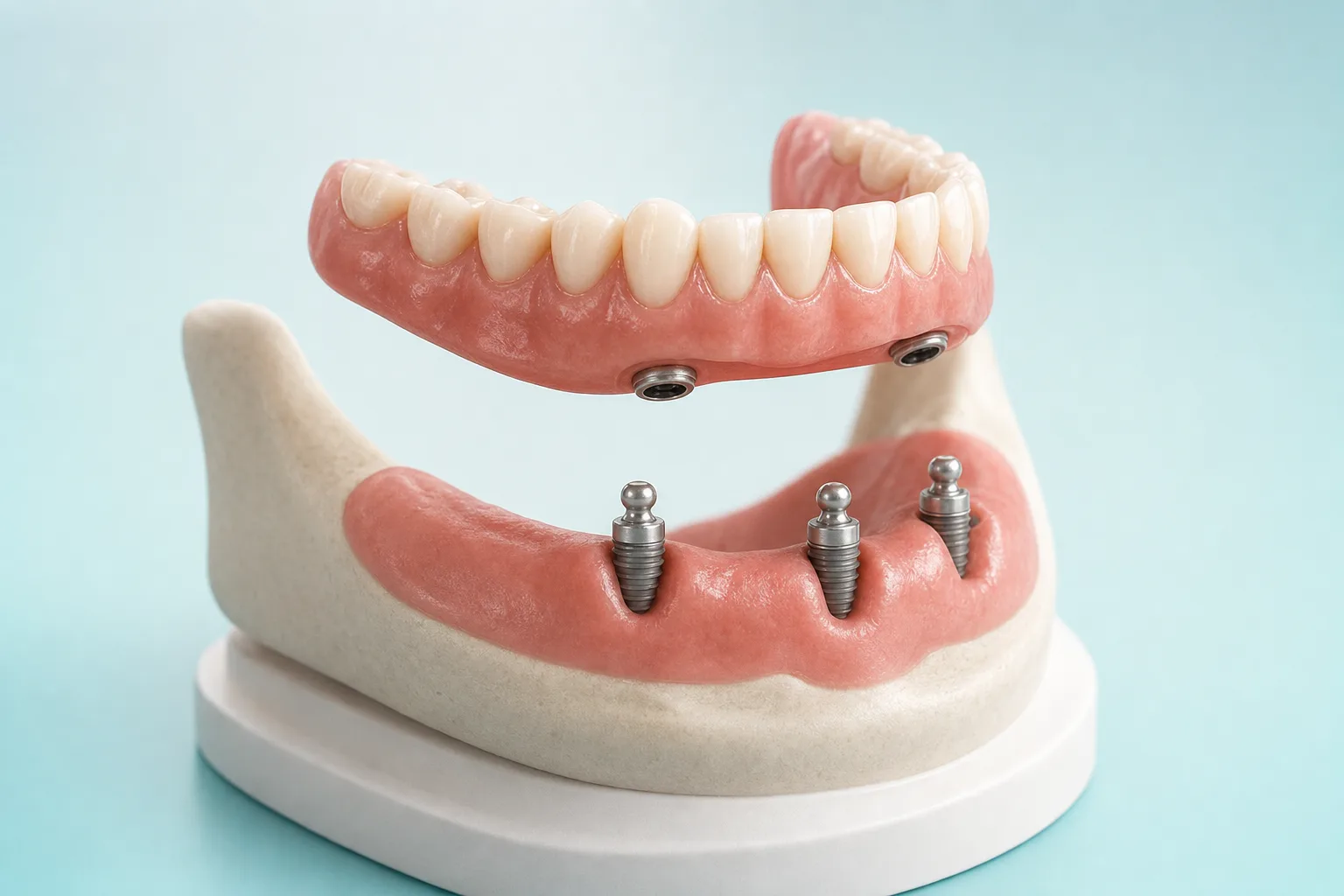
A lower complete denture rests on a ridge that keeps resorbing, and for some patients no amount of adjustment produces a denture that stays put while eating. Implants solve that mechanically, and the program does not cover them.
The realistic pathway is staged: take the covered denture now, and pursue implant retention later as a self-pay step. We provide removable overdentures on four implants, and in many cases the plan is built so the prosthetic side is handled through the benefit while the surgical side is financed separately. CareCredit, Cherry and Sunbit are the three routes patients here use most often for that second stage.
What Denti-Cal does not cover for adults
- Dental implants — not a routine benefit. Authorization exists only in narrow, heavily documented circumstances, and planning around it is not realistic for most patients.
- Whitening, veneers and elective cosmetic work — excluded outright, with no exception pathway.
- Adult orthodontics — generally not covered. Medically necessary categories such as cleft palate are handled under separate criteria, not as ordinary braces coverage.
- Molar root canals for adults — as above, absent documented contraindication to extraction.
- Material upgrades — if the covered benefit is a prefabricated crown and you want porcelain, the difference is yours.
- Night guards for grinding — occlusal guards are generally outside the adult benefit, even when the clenching is clearly damaging teeth.
Does Medicare cover dental work?
Patients conflate Medicare and Medi-Cal constantly, and the conflation costs them, so it is worth separating cleanly.
Original Medicare (Parts A and B) does not cover routine dental care. No cleanings, no fillings, no dentures, no extractions done for ordinary dental reasons. What it can cover is dental treatment that is integral to a covered medical service — jaw reconstruction after an accident, or dental clearance and treatment before certain organ transplants, cardiac valve procedures and head-and-neck cancer treatment. That is a narrow medical carve-out, not a dental benefit.
Medicare Advantage (Part C) plans frequently include dental, and this is where expectations run ahead of reality. The benefit is typically an annual allowance with its own maximum, network restrictions and frequency limits. A single crown or a denture can consume most of a year's allowance, and unused dollars do not roll forward.
If you carry both cards, dental generally runs through Medi-Cal Dental, not Medicare. Say that on the phone when you book — "I have Medicare and Medi-Cal" — because it changes how the visit is verified before you ever sit in the chair.
Eligibility changes worth tracking
Adult dental eligibility for some Medi-Cal members is scheduled to change, with July 1, 2027 currently on the calendar. If you think you may be in an affected group, do not take a summary page's word for it — confirm your own status through your county office or the Medi-Cal Dental member line, and do it before you start a multi-visit treatment plan rather than partway through one.
When the coverage question has to wait
Get seen urgently if… your face or jaw is swelling, you have a fever alongside tooth pain, the swelling is closing an eye or crossing toward your throat, or you are having trouble swallowing or breathing. Difficulty swallowing or breathing is an emergency room trip right now, not a dental appointment. Emergency dental exams and pain relief are covered benefits and do not wait on prior authorization.
One detail worth carrying with you: an emergency room can give you antibiotics and pain medication, but hospitals generally cannot perform a root canal, extract the tooth, or drain the infection at its source. The tooth still has to be treated by a dentist, usually within a day or two. Our emergency dental care page covers what to do in the meantime.
Six questions worth asking before treatment starts
- Which parts of this plan need prior authorization, and have they been submitted? Dates matter here more than reassurance.
- What happens if the authorization is denied — what is plan B for this tooth? Every serious plan has one.
- How much of my annual limit does this plan use, and what is left? The office can check where your benefit year stands.
- Which treatment is urgent and which can wait until the limit resets? Sequencing is the whole game with a capped benefit.
- Is this crown prefabricated or laboratory-made? The answer tells you what you are actually getting.
- What is not covered here, and what would it cost me? Ask for it in writing before anything is started.
When the benefit runs out before the treatment does
It happens, particularly in a first year when there is a backlog of work. Two things generally bridge the gap. Our in-house membership plan is built for people without dental coverage and covers the preventive side on a flat annual basis — details on the membership plan page. For larger treatment, third-party financing spreads it monthly. We have also written a fuller breakdown of what dental care costs without insurance for anyone weighing the options.
Neither one replaces the benefit. Both keep a treatment plan moving instead of stalling it for eight months, which is usually the difference between a filling and a crown.
Bring your card and your questions
If you have Denti-Cal or Medi-Cal and you are not sure what your plan actually covers, Dr. Sameer Aljanedi and our bilingual team can check your benefits, tell you which parts need authorization and how long that takes, and put the uncovered portion in writing before anything begins. Se habla español — book a visit at our Downey office or call (562) 928-5559.
Have questions about your smile?
Dr. Sameer Aljanedi and the team at Rio Hondo Dental Office are here to help. Se habla español.