Insurance & Costs
Why Your Dental Insurance Denied Your Implant: 4 Reasons

The letter says "not a covered benefit" and stops there. No tooth number, no plan language, no hint as to whether the problem is your policy, your timing, or a missing X-ray in the submission.
Dental plans turn down implant claims for four specific reasons. Which one applies decides whether you have an argument worth making or a contract term you cannot move.
Why did my dental insurance deny my implant?
Short answer: Most implant denials come down to one of four things: a missing-tooth clause that excludes teeth lost before your coverage began, an unmet waiting period on major services, a separate implant maximum set below your annual maximum, or an alternate-benefit downgrade that pays toward a bridge instead. The denial wording tells you which one you are dealing with.
One distinction first, because plans use nearly identical language for both: a true denial pays zero, while a downgrade pays something and leaves you the difference. Patients read the second as the first all the time and walk away from treatment that was partly funded. Our front desk verifies benefits before treatment for every plan we take, and you can check which PPO, HMO and Denti-Cal and Medi-Cal coverage we accept before you come in.
The four ways a plan says no
1. The missing tooth clause
This one catches the most people, and almost nobody learns it exists until a claim comes back. A missing-tooth clause excludes coverage for replacing any tooth that was already gone on the day your policy took effect. Not the day you first had dental insurance in your life. The effective date of this plan. Lose a molar in 2023, change jobs in 2025, ask the new plan to fund an implant in that space, and the clause applies even though you have been continuously insured the whole time.
In your plan documents it sits under exclusions and is worded something like "teeth missing prior to the effective date of coverage" or "replacement of teeth extracted before the member became eligible." Some employer plans drop the clause after a defined stretch of continuous enrollment, commonly a year or two. Some carry it for the life of the policy. A few give credit for prior continuous coverage if you enrolled without a gap, which is worth asking about specifically, because it is rarely volunteered.
Appealing this one rarely works. It is a contract exclusion, not a clinical judgment, and no amount of narrative from your dentist changes what the policy says. What can change it is open enrollment: if a plan option without the clause exists, that is where the fix lives.
2. A waiting period you have not finished
New policies commonly stage their benefits. Preventive care usually starts immediately. Basic work such as fillings often opens at three to six months. Major services, which is where implants sit alongside crowns, bridges and dentures, frequently wait six to twelve months, and some individual-market policies stretch that toward two years.
This denial is a calendar problem, not a judgment about your tooth, and calendar problems can be worked with. Implant treatment is already staged over months. Extraction, socket preservation or bone grafting, and the healing interval before placement can all run while the waiting period runs, so the surgical phase lands on the far side of it rather than being postponed as a block.
Two things to confirm before you build a plan around this. First, whether the waiting period applies separately to each service category, since grafting and extraction may fall in a different tier than the implant itself. Second, whether your plan penalizes late enrollment with a longer wait, which several do.
3. An implant sub-maximum, or no implant benefit at all
Your annual maximum is the ceiling on what the plan pays across all treatment in a benefit year. Many plans sit somewhere between $1,000 and $2,500. Patients assume that ceiling is the only one.
Plenty of policies add a second, lower ceiling that applies to implants alone. It may be annual, and it may be a lifetime figure that never resets no matter how many years you pay premiums. A plan with a $2,000 annual maximum can carry a $1,000 lifetime implant maximum underneath it, which is functional coverage for roughly a third of one tooth. Other plans skip the ceiling entirely and exclude implants as a category, which produces the flat "not a covered benefit" line that started this article.
You cannot appeal a maximum. You can plan around one. Because most maximums reset with the benefit year, splitting a case across two years is legitimate and common: surgical placement late in one year, the abutment and crown early in the next. Whether that is clinically sensible depends on healing, not billing, so it is a conversation to have before treatment rather than after. Our guide to how PPO and HMO plans differ on major work gets into where these ceilings usually sit, and a mid-year benefits check tells you what is left before the reset.
4. Alternate benefit: the plan bought you a bridge instead
This is the mechanism patients misread most often. An alternate-benefit provision, sometimes called least expensive alternative treatment, lets the carrier pay toward the cheapest procedure that would restore the area rather than the one you and your dentist chose. Ask for an implant, and the plan calculates what it would have paid toward a three-unit bridge or a partial denture and sends that amount.
It looks like a denial on the statement. It is not. Money moved. The line usually reads "benefit limited to alternate procedure" or "processed as an alternate benefit," and the difference between that allowance and the actual fee is yours.
Two consequences nobody explains. The alternate allowance still draws down your annual maximum, so it is not free money sitting outside the ceiling. And this is the mechanism most open to appeal, because it rests on a clinical claim: that the cheaper option would work here. If the teeth on either side of the gap are healthy and unrestored, a bridge means grinding down two sound teeth to replace one, and that argument belongs in writing from your dentist. If the ridge form or the opposing arch makes a removable partial unstable, that is documentable too. Carriers do reverse these. Not always, but often enough to be worth the letter. If you are still weighing the options themselves, we compare them in what actually replaces a missing tooth and in our look at implants versus bridges.
| What the statement says | What it actually means | Is it worth appealing? |
|---|---|---|
| "Tooth missing prior to effective date" | Missing-tooth clause. The tooth was already gone when this policy began. | Rarely. Contract exclusion. Check for a continuous-coverage credit, or change plans at open enrollment. |
| "Waiting period not satisfied" | Major services are locked for a set stretch after enrollment. | No, but you can sequence extraction, grafting and healing inside the wait. |
| "Maximum benefit reached" or "implant benefit limit" | Annual maximum spent, or a separate implant cap, sometimes a lifetime one. | No. Split treatment across benefit years, or fund the gap another way. |
| "Benefit limited to alternate procedure" | The plan paid toward a bridge or partial, not the implant. Partial payment, not zero. | Often yes, with a clinical narrative on why the cheaper option is inappropriate. |
| "Insufficient information to process" | The paperwork failed, not the claim. Missing radiograph, narrative, extraction date or tooth number. | Yes. The most winnable category, and usually just a resubmission. |
The denial that is not really a denial
A meaningful share of implant claims come back rejected because something was missing from the submission, not because the plan excludes the treatment: a pre-operative film or scan showing the site, the date the tooth was extracted, a narrative explaining why an implant rather than an alternative, correct tooth numbering, an itemized breakdown separating the fixture from the abutment and crown.
These arrive with the same cold language as a genuine exclusion. Before you accept the outcome, call the carrier and ask the specific question: was this denied under a plan exclusion, or for missing information? The answer takes two minutes and changes what you do next entirely.
Ask for a predetermination before treatment, not after
The single most useful thing you can do about an implant denial is prevent it. A predetermination, also called a pre-treatment estimate, is a claim submitted before any work starts. Your dentist sends the proposed treatment plan, radiographs and supporting narrative; the carrier returns in writing what it expects to pay and what it will not.
Turnaround commonly runs two to four weeks. A predetermination is not a payment guarantee, since it stays subject to your eligibility and remaining benefits on the day of service, but it converts most of the surprise into arithmetic you can see in advance. It also surfaces missing-tooth clauses and sub-maximums before you have committed to anything.
The American Dental Association's consumer site, MouthHealthy, has a plain-language primer on how dental benefits are structured if you want the background before that call.
How to appeal an implant denial
- Get the exact reason in writing. Call the number on your card and ask which provision the denial was issued under. Request the plan document language, not a paraphrase.
- Pull your Evidence of Coverage. The exclusions section and the definitions section are where missing-tooth clauses and sub-maximums live. Both are usually downloadable from the member portal.
- Have the office assemble the clinical file. Pre-operative imaging, the restorative and periodontal status of the adjacent teeth, the extraction date, and a narrative stating why the alternate procedure is not appropriate for this specific mouth.
- File in writing, inside the window. Appeal deadlines commonly run 60 to 180 days from the denial date. Send it in a form that creates a record, and keep a copy.
- Escalate if the first level fails. Most plans have a second-level internal review, and California dental coverage is regulated by either the Department of Managed Health Care or the Department of Insurance depending on how the product is written. Your denial notice should name the agency that handles external complaints.
Set your expectations by mechanism. Appeals built on documentation and clinical necessity win reasonably often. Appeals against a plain contract exclusion almost never do, and spending three months on one usually costs more in delay than it recovers.
Get seen urgently if... the site is actively infected while your appeal is pending. Facial swelling, spreading pain, a bad taste draining from the socket, fever, or trouble opening or swallowing means the infection needs treatment now, regardless of coverage status. Insurance timelines and clinical timelines are unrelated, and an infection does not wait for a carrier's review.
If the denial holds, what actually gets people treated
Most patients who end up with an implant after a denial use some combination of the following, not a single fix.
- Two benefit years. Where healing allows it, staging the surgical and restorative phases across a maximum reset draws on two annual ceilings instead of one.
- Pre-tax dollars. FSA and HSA funds generally apply to implant treatment. FSA balances often expire at year end, which makes December a real deadline rather than a marketing one.
- Financing spread over months. We work with CareCredit, Cherry and Sunbit, and our payment and financing options page explains how each one is structured. Our in-house membership plan is a separate route for patients with no coverage at all.
- Medical rather than dental. Uncommon, but worth one phone call: tooth loss from documented facial trauma, or from treatment for a medical condition, is occasionally handled on the medical side.
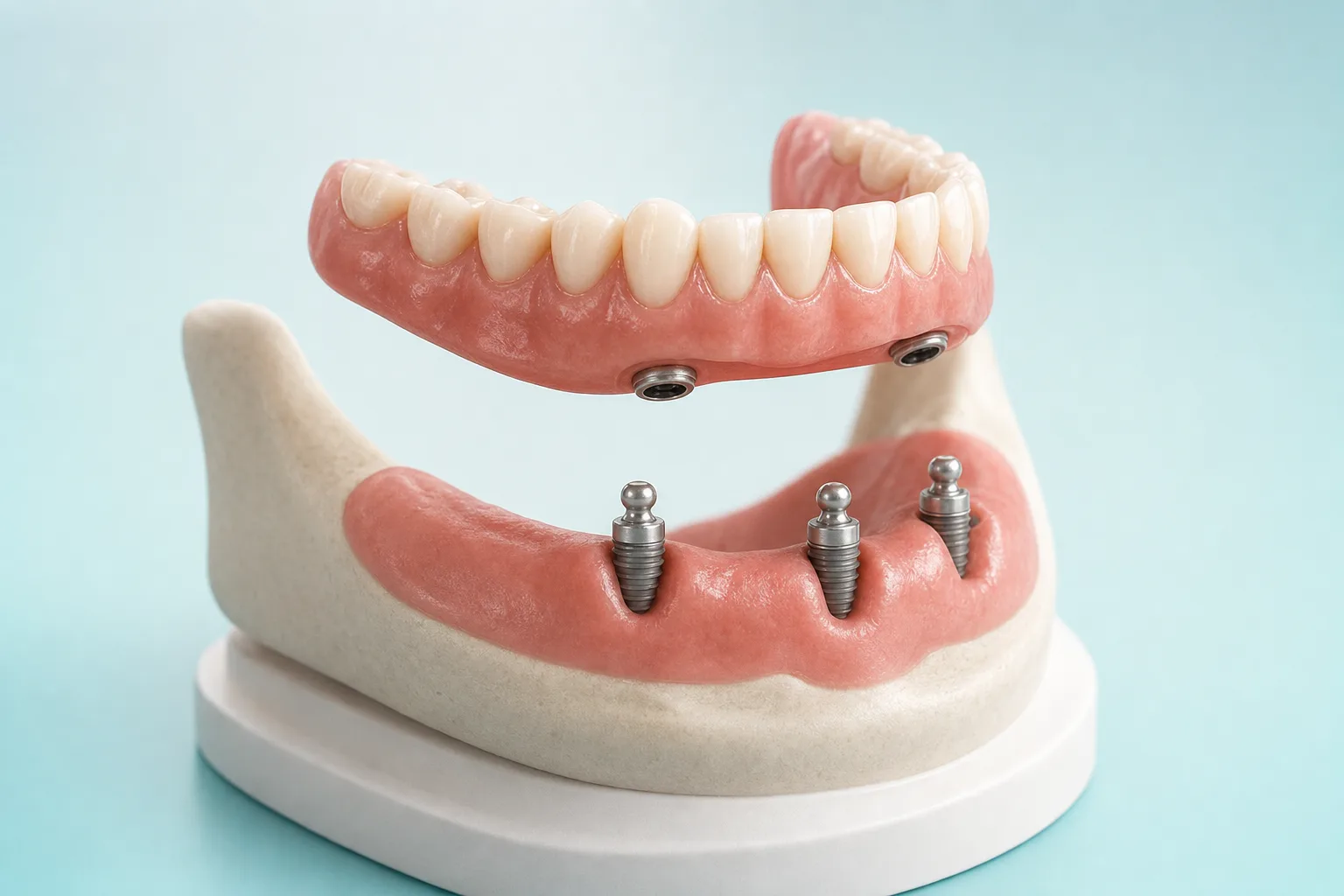
- A different treatment. If the number will not work, it will not work. A bridge, a partial denture, or for a whole arch a removable overdenture retained by four implants are real options rather than consolation prizes, and the last one is what we provide for full-arch cases.
One note specific to public coverage: implants are not a routine Denti-Cal or Medi-Cal benefit for adults, so a denial there is generally a program rule rather than a claims error. The denture and extraction side of the program works differently. Benefit rules change, so confirm current specifics with our office or with the state program before planning around them.
Four questions to ask before you sign a treatment plan
- Does my plan have a missing-tooth clause, and when was this tooth lost? Ask both halves together. The dates decide the answer.
- Is there a separate implant maximum, and is it annual or lifetime? A lifetime cap never resets, which changes the entire strategy.
- Will you submit a predetermination first? Any office that places implants should say yes without hesitating.
- What will the itemized estimate include? Imaging, extraction, grafting, the fixture, the abutment, the crown and follow-up visits should each appear as a line. Advertised implant prices usually cover the fixture alone, which is why quotes vary so wildly. Our breakdown of implant costs and payment options covers what belongs on that list.
Bring us the denial letter
If a claim came back rejected and the wording means nothing to you, bring the statement and your plan documents in. Dr. Sameer Aljanedi and our team will read the actual exclusion, tell you honestly whether an appeal is worth filing, and lay out what implant treatment would involve either way. Se habla español. Schedule a consultation or call (562) 928-5559.
Have questions about your smile?
Dr. Sameer Aljanedi and the team at Rio Hondo Dental Office are here to help. Se habla español.