Insurance & Costs
Does Denti-Cal Cover Dental Implants in California?
Denti-Cal does not pay for dental implants as a routine benefit. That is the straight answer, and most pages ranking for this question take 800 words to admit it. The more useful question is what the program does cover when you are missing teeth — because that part is more generous than people expect, and a lot of patients never find out.
Does Denti-Cal cover dental implants?
Short answer: No. Implants are not a standard covered benefit for adults under Denti-Cal (Medi-Cal Dental). A limited implant benefit exists in state law, but its start date has been pushed back more than once and now sits at July 1, 2027 — and even then it is expected to be narrow and require prior authorization. Dentures, partials, relines and repairs are covered today.
Generally covered for adults
- Exams, X-rays and cleanings at set intervals
- Fillings, extractions and many root canals
- Complete (full) dentures, upper and lower
- Partial dentures, including immediate partials in many cases
- Denture relines, rebases, repairs and adjustments, with timing rules
- Laboratory and prefabricated crowns in defined circumstances
- Fixed bridges — but only in narrow, documented situations
Generally not covered
- Implant placement surgery
- Abutments, attachment housings and implant-supported crowns
- Bone grafting or sinus lifts done to make implants possible
- Cosmetic treatment — whitening, veneers, elective reshaping
- Anything the program treats as an upgrade over a functional covered alternative
We accept Denti-Cal and Medi-Cal, and our Denti-Cal and insurance coverage page explains how we verify benefits before anything gets scheduled. Eligibility is checked per visit and can change month to month, so a card in your wallet is not proof you are active this week.
Can implants ever be approved through prior authorization?
Almost never for the reason people hope. Medi-Cal Dental runs on the Treatment Authorization Request, or TAR — your office submits X-rays, photos, chart notes and a justification, and the program returns a Notice of Authorization approving or denying specific procedure codes. Crowns, dentures and some root canals move through this process routinely.
Implants are different. The program's position has consistently been that a removable prosthesis is the covered way to replace missing teeth, so an implant request submitted because a patient would prefer implants comes back denied. The rare approvals involve documented medical circumstances — jaw reconstruction after cancer surgery or major trauma, or a congenital condition affecting jaw development — and those cases are usually managed in a hospital or oral surgery setting rather than a general practice.
Fixed bridges follow similar logic. A bridge can be authorized when there is a documented medical reason a removable partial cannot be worn: a severe gag reflex, a seizure disorder, certain neurological conditions. "I do not like the idea of taking it out at night" is not that reason, however understandable it is.
One practical note. If your situation genuinely fits one of those categories, ask your office to submit anyway. A denial costs you nothing and creates a paper record. What you should never do is begin treatment assuming approval will arrive.
What about the July 1, 2027 date?
California authorized a limited adult implant benefit in a budget package, then delayed implementation as budget conditions shifted. The current implementation date is July 1, 2027. Delays like this have happened before with Medi-Cal Dental benefits, and the details — who qualifies, which procedure codes are included, what documentation is required — have not been finalized in a way anyone should build plans around.
What that means for you: do not put your mouth on hold for two years to see what happens. Missing teeth are not a stable situation. The bone that held a tooth root begins remodeling within months of extraction, and the teeth on either side drift toward the gap. Waiting can turn a straightforward case into one that needs grafting first.
What Denti-Cal covers instead — the full picture
| Option | Denti-Cal coverage | What it means for you |
|---|---|---|
| Extracting a hopeless tooth | Covered | Usually the first step; do not delay it while you decide about replacement |
| Complete denture (per arch) | Covered with prior authorization | Commonly limited to once per arch within a five-year window |
| Partial denture | Covered with prior authorization | Resin-based partials are routine; cast metal frameworks need stronger justification |
| Immediate denture | Covered in many cases | Delivered as teeth come out, so you are not without teeth while gums heal |
| Reline, rebase, repair, adjustment | Covered with timing rules | Typically not in the first months after delivery, then roughly annually |
| Fixed bridge | Rarely — documented medical need only | Preferring a fixed option is not sufficient justification |
| Single implant with crown | Not a routine benefit | Self-pay or financed |
| Overdenture on implants | Implants and attachments not covered | The denture portion may be covered on its own merits — see below |
Two limits worth knowing before big work is planned. Adult benefits have historically carried an annual dollar cap on certain services, with exceptions for defined categories of care. And prior authorization takes real calendar time — weeks, not days. If you need a denture before a wedding or a job that starts in six weeks, say so at the first visit so the paperwork goes out immediately.
Does Medi-Cal cover the denture part of an implant overdenture?
This is the sharpest question patients ask, and the answer is genuinely case-by-case.
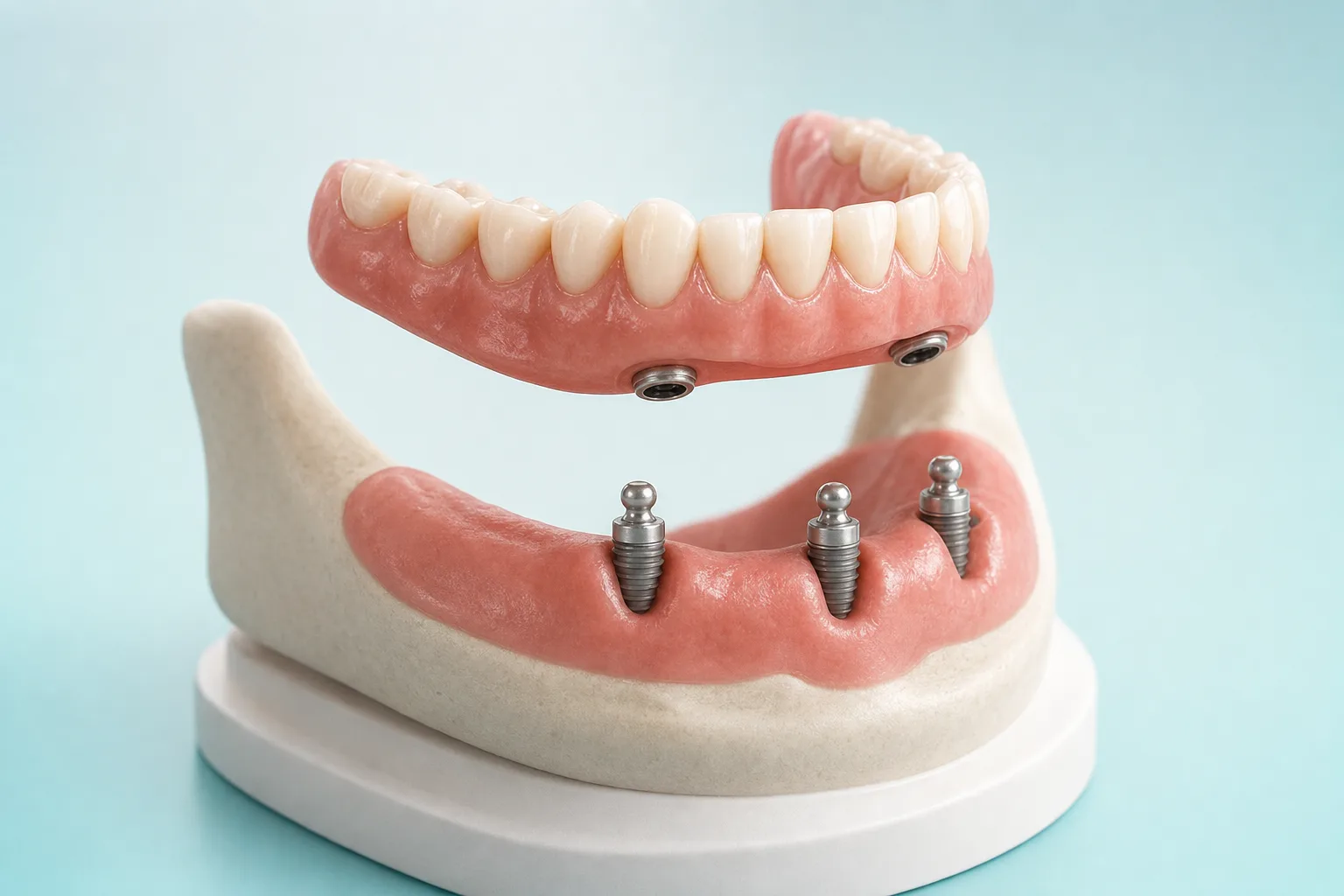
A removable overdenture that snaps onto four implants is two things stacked together: a denture, and the implants plus attachment hardware holding it in place. If you independently qualify for a covered denture, the denture itself may be a benefit. The implants, the abutments, the attachment housings and the laboratory work to build or convert a prosthesis to fit those attachments are not.
It gets complicated because coverage can hinge on how the case is coded and documented — an implant-retained overdenture is not the same procedure as a conventional complete denture. Do not assume either way based on an article, this one included. Have the office run your eligibility and get a determination in writing before you spend a dollar on the implant side. For background on the prosthesis itself, our pages on full and partial dentures and on implant-supported dentures explain how each is made and how they feel day to day.
The staged pathway most patients actually use
Very few people pay for implants in one go. Here is the sequence that works, and it is deliberately unglamorous:
- Get seen and get a written plan. Exam and X-rays are covered. Ask for covered and non-covered items on separate lines.
- Deal with infection and hopeless teeth first. Extractions and fillings are covered, and nothing else can be planned around an active infection.
- Get the covered denture or partial. Authorization goes out, approval comes back, impressions and try-ins follow. Figure on roughly two to three months from first appointment to delivered prosthesis once authorization clears — longer if extraction sites need to heal first.
- Wear it, and reline it on schedule. Gums shrink for six to twelve months after extractions. Relines and repairs are covered at set intervals and they make an enormous difference to fit.
- Save or finance the implant portion separately. This is where CareCredit, Cherry and Sunbit financing and our in-house membership plan come in. Nothing about this step is on a deadline.
- Add implants when you are ready. Two to four implants in the lower jaw change denture stability more than anything else available. Placement, then healing of roughly three to six months, then attachments fitted to the prosthesis.
The honest drawback of staging it this way: you may pay for laboratory work twice, because a denture built for a bare ridge sometimes cannot be converted cleanly and a new one is needed. Raise this at step three. A dentist who knows implants might be in your future can design the denture with that in mind.
What actually drives the out-of-pocket cost
There is no single implant price, and any office quoting one number over the phone is leaving items out. The total is a stack of separate charges:
- How many implants. Two implants noticeably stabilize a lower denture. Four gives more retention and spreads the load better.
- Whether you need bone first. Grafting or a sinus lift adds a surgical stage and several months of healing before implants can go in.
- Imaging. A 3D scan to map nerve position and bone volume is standard for surgical planning.
- Attachment hardware. Locator-style attachments use replaceable inserts that wear and need swapping periodically — a small recurring cost almost nobody mentions upfront.
- Whether your existing denture converts or a new one is made. Often the single biggest swing in the total.
- Medical complexity. Longer healing intervals, more visits, sometimes a physician consultation.
Our guide to dental implant treatment covers the surgical side in more detail, and the week-by-week healing guide describes what recovery genuinely feels like rather than the brochure version.
What can disqualify you — or delay you
Implants are not right for everyone, and learning that before you finance anything saves real money. Common reasons a dentist will pause or decline:
- Not enough bone. The lower back jaw sits close to a major nerve; the upper back jaw sits beneath a sinus that expands after teeth are lost. Both are workable, but working around them adds months.
- Uncontrolled diabetes. Blood sugar control affects healing and infection risk. Well-controlled diabetes is generally not a barrier.
- Smoking. Failure rates run higher, particularly during early healing. Many surgeons ask for a period of abstinence around surgery.
- Active gum disease. Bone loss around your remaining teeth predicts bone loss around implants. Gum treatment comes first, not after.
- History of intravenous antiresorptive medication or head and neck radiation. Both raise the risk of poor jaw healing and call for careful medical consultation.
- Heavy grinding. Manageable, but it needs a night guard and a plan for it.
- Not able to attend follow-ups. This is a year-long process with several checkpoints. Missing them is how small problems turn into failures.
If you want a non-commercial source while you think it over, the National Institute of Dental and Craniofacial Research keeps plain-language background on tooth loss and jawbone health at nidcr.nih.gov.
Six questions to ask before you agree to anything
- Will you submit this for authorization, and how long does that usually take?
- Can I have the plan in writing, with covered and non-covered items on separate lines?
- How much of my annual benefit have I already used this year?
- If I get a denture now, can it later be converted to snap onto implants — or would I need a new one?
- What happens if authorization is denied? What is the cost then, and what are my options?
- Who replaces the attachment inserts when they wear out, and what does that cost?
An office that works with the program regularly answers all six without hesitating. Hesitation is information.
What happens if you keep waiting
The ridge of bone that held a tooth root loses height and width fastest in the first year after the extraction and keeps remodeling slowly afterward. Opposing teeth drift down into the empty space. Neighbors tip toward it. Chewing shifts to one side, which loads the jaw joint unevenly. A denture made for a ridge that has been resorbing for a decade fits worse than one made earlier, simply because there is less shape left to hold onto.
None of that is cause for panic. It is a reason not to treat a two-year wait as free.
Get seen urgently if… you have facial swelling, fever, pain that wakes you at night, or trouble swallowing or opening your mouth — a spreading dental infection is a medical problem, not a dental inconvenience. Come in promptly, too, for any sore under a denture that has not healed within two weeks. Most are simple pressure spots that need an adjustment, but an ulcer that persists needs a proper look.
Where to start
If you have Denti-Cal and you are missing teeth, the appointment worth booking is the one that tells you exactly what your benefits pay for right now — not the one you keep postponing until implants become affordable. Dr. Sameer Aljanedi and our bilingual team will verify your eligibility, separate covered from non-covered work in writing, and tell you honestly whether implants make sense for you down the road. Call (562) 928-5559 or request a visit at our Paramount Blvd office in Downey. Se habla español.
Have questions about your smile?
Dr. Sameer Aljanedi and the team at Rio Hondo Dental Office are here to help. Se habla español.