Emergency Care
Tooth Abscess: Symptoms, Stages and Why Antibiotics Alone Won’t Fix It
The throbbing kept you up three nights running. Then one morning it was simply gone, and in its place there is a small bump on the gum that leaks something salty when you press it. That is not a tooth that got better. That is an abscess that found a way to drain.
Here is what is going on inside the tooth, how far along it probably is, and why the prescription you may be hoping for will not finish the job.
What is a tooth abscess, and will it go away on its own?
Short answer: A tooth abscess is a pocket of pus from a bacterial infection at a root tip or in the gum beside a tooth. It does not heal on its own, and antibiotics only quiet it for a while. Real treatment drains it and removes the source with a root canal, an extraction or a gum cleaning. Facial swelling, fever or trouble swallowing needs care that same day.
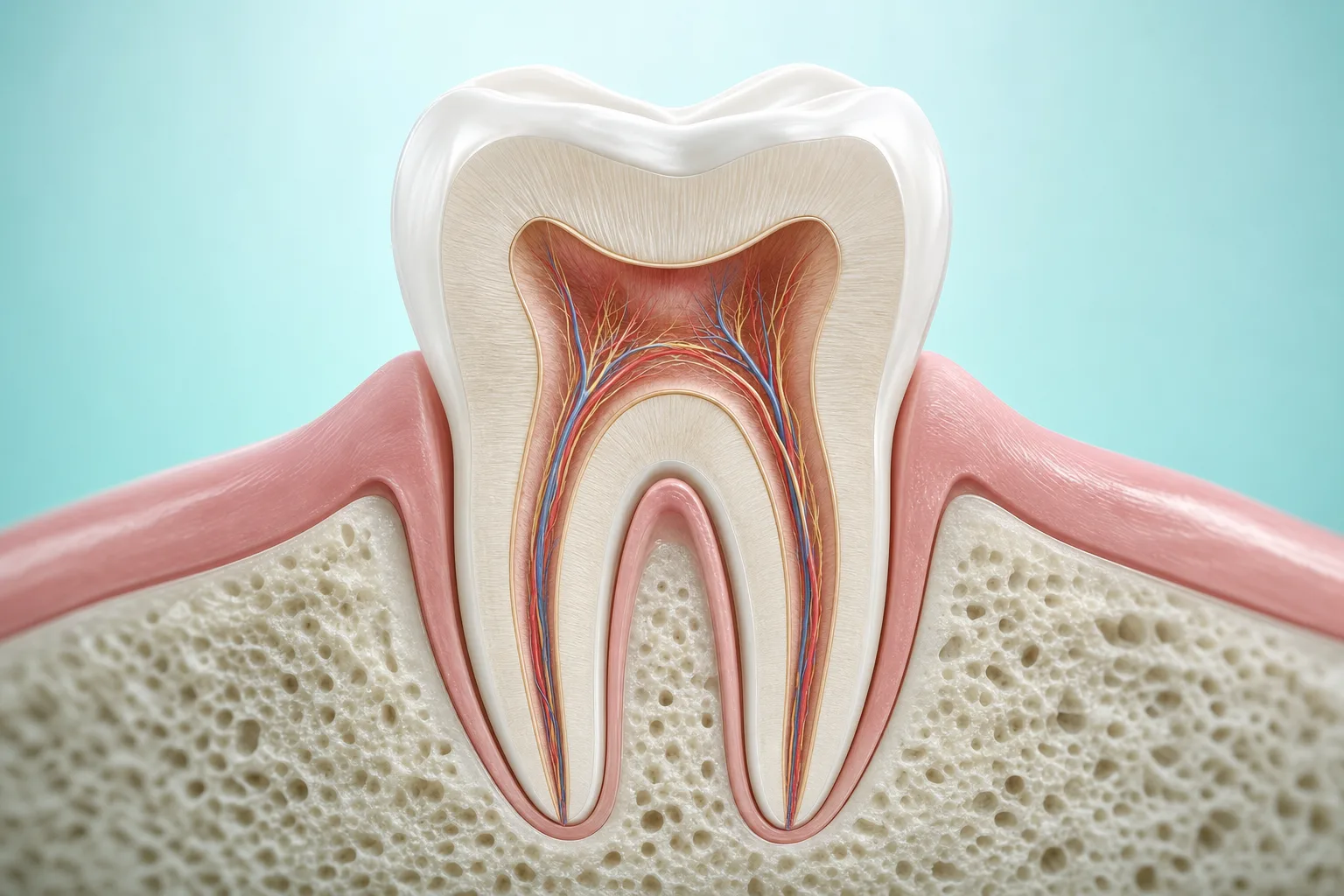
Your body is good at walling off bacteria, and that is all an abscess is: a sealed-off collection of pus where the immune system has fought an infection to a standstill. What it cannot do is reach the source. Inside a dead tooth there is no blood flow, so no immune cells arrive and nothing clears the bacteria living in the canals. The standoff holds until someone removes the source, which is the whole point of an urgent dental visit for swelling or infection instead of waiting to see what it does next.
What does a tooth abscess look and feel like?
Not every abscess announces itself with a swollen cheek. These are the common signs, roughly in the order people notice them:
- A deep, throbbing ache that may travel to the ear, temple or jaw on the same side
- A tooth that feels "tall," as if it hits first when you close, and is sore to tap or chew on
- A pimple-like bump on the gum near the root, sometimes oozing
- A sour or salty taste, and breath that will not freshen no matter how much you brush
- Puffy, red gum tissue, or swelling in the cheek, lip or under the jaw
- Tender glands under the jaw or along the neck
- Fever and feeling run down once the infection starts to spread
One sign gets missed constantly: the tooth often stops reacting to cold altogether. A tooth that screamed at ice water last month and feels nothing now has usually lost its nerve, not recovered.
Periapical vs. periodontal abscess: which one is it?
Two different infections get called "an abscess," and they are treated differently.
| Periapical abscess | Periodontal abscess | |
|---|---|---|
| Where it starts | Inside the tooth; pus collects in the bone at the root tip | In the gum pocket alongside the root |
| Usual cause | Deep decay, a crack, an old blow to the tooth, a leaking filling or crown | Gum disease, or something wedged under the gum such as a popcorn hull |
| The tooth's nerve | Usually dead; no response to cold | Often still alive |
| Where the swelling sits | Over the root, away from the gumline | At or near the gumline; the tooth may feel loose |
| Typical treatment | Root canal or extraction | Drainage and cleaning of the pocket; extraction if the bone support is gone |
A third kind forms under the gum flap around a partly erupted wisdom tooth. It shows up mostly in the late teens and twenties and is one of the usual reasons a wisdom tooth ends up coming out.
You cannot reliably tell these apart in a bathroom mirror. A dentist sorts them out with an X-ray, a cold test and a probe that measures the depth of the gum pocket.
The four stages of a tooth infection
An abscess is rarely the beginning. It is usually stage three of a process that started months earlier, and each stage feels different.
| Stage | What is happening | What you feel | Usual fix |
|---|---|---|---|
| 1. Pulpitis | Bacteria from decay or a crack inflame the nerve. Early on the nerve can recover; later it cannot | Cold sensitivity that stops in seconds at first, then lingers. Eventually pain with no trigger, often at night | A filling while it is reversible; a root canal once it is not |
| 2. Necrosis | The nerve tissue dies and bacteria colonize the empty canals | Often nothing at all. The pain fades and the tooth may slowly darken | Root canal or extraction |
| 3. Abscess | Infection leaves through the root tip into the jawbone and pus forms. It may tunnel out through a bump on the gum | Throbbing, pressure, a tooth too sore to bite on. Or a painless draining pimple | Drainage plus a root canal or extraction |
| 4. Spreading infection | Bacteria move past the bone into the soft tissues of the face and neck | Visible facial swelling, fever, difficulty opening wide or swallowing, feeling ill | Urgent care: drainage, antibiotics, sometimes a hospital stay |
How fast does it move? Nobody can tell you honestly. Some teeth sit quietly at stage two or three for years. Others go from the first twinge to a swollen face in under a week. The speed depends on the bacteria involved, the anatomy of that particular root and your general health. Poorly controlled diabetes and medications that suppress the immune system both tilt things the wrong way.
Stage one is the cheapest and easiest place to stop all of this, which is why the early signs of a dying nerve are worth knowing.
Why did the pain suddenly stop?
Two possible reasons. Neither one is healing.
The first is that the nerve died. Pulpitis hurts because living nerve tissue is being squeezed inside a hard chamber with no room to swell. Once that tissue is dead, there is nothing left to send the signal. The bacteria are still there, and now they have the whole canal system to themselves.
The second is that the pressure found a way out. Pus trapped in bone is what makes an abscess throb. Given enough time it tunnels through the bone and gum and opens on the surface as that small pimple, which dentists call a sinus tract or gum boil. It can swell, drain and flatten in cycles for months, leaving a bad taste each time. Because the pressure is venting, it frequently does not hurt at all.
A painless draining bump still needs treatment. The infection at the root keeps dissolving bone the entire time, and the dark shadow on the X-ray keeps growing, sometimes far enough to involve the tooth next door. The drain can also seal over. When it does, pressure and pain come back fast. And in a child, an abscess on a baby tooth sits right beside the developing permanent tooth and can damage it.
Why won't antibiotics alone cure a tooth abscess?
Because the drug never reaches the bacteria that matter. Antibiotics travel in the bloodstream. A dead tooth has no blood moving through it, so the colony inside the canals goes untouched. What the medication can do is knock back the bacteria that have escaped into the surrounding tissue. The swelling goes down and you feel better for a few weeks, maybe a few months. Then the tooth reseeds the infection and you are back where you started, usually at a worse moment.
This is the mainstream position, not just ours. The American Dental Association's guideline on antibiotics for dental pain and swelling tells dentists to prioritize treating the tooth itself in otherwise healthy adults with a localized infection, and to add antibiotics when the infection shows signs of affecting the whole body, such as fever or malaise.
So when are they the right call? When there is fever, swelling moving into the face or neck, or a medical condition that weakens your immune response. Even then they are paired with treatment of the tooth, never used in place of it. Every round taken without fixing the source has its own costs: stomach upset, the occasional allergic reaction, and bacteria that respond less well next time. Leftover pills from an old prescription are the worst version of this. Wrong drug, wrong dose, too few days.
How is a tooth abscess actually treated?
Every real treatment does the same two things: lets the pus out and removes whatever is feeding it.
- Drainage. If there is a soft, pointed swelling, the area is numbed and opened to release the pressure. Often the drainage happens through the tooth itself as the first step of a root canal. Relief tends to be quick, but drainage by itself is a first step and not a cure.
- Root canal treatment. For a periapical abscess on a tooth worth keeping, root canal therapy removes the dead tissue, disinfects the canals and seals them. With the source gone, the bone repairs itself. Back teeth usually need a crown afterward.
- Extraction. When a tooth is cracked through the root, decayed below the bone level or has too little structure left to hold a crown, removing the tooth clears the infection just as completely. The trade-off is a gap you then have to decide about.
- Gum treatment. A periodontal abscess is drained through the pocket and the root surface is cleaned, commonly followed by scaling and root planing to deal with the gum disease behind it.
Saving versus pulling comes down to how much sound tooth is left, where the tooth sits in your bite and what replacing it would involve. Our guide to choosing between a root canal and an extraction covers that decision in detail.
One honest warning: a badly infected tooth can be harder to numb. Inflamed tissue blunts local anesthetic, so it may take more of it, a different injection technique or a few extra minutes of waiting. Speak up if you feel anything sharp. Your dentist would much rather stop and add more than have you grip the armrests.
What recovery really feels like
The pressure pain commonly eases within a day or two of drainage or the first root canal visit. The tooth stays tender to chew on for several days, sometimes a week or two. Swelling should shrink a little every day; swelling that grows after treatment is a reason to call. A draining gum bump usually closes within a couple of weeks once the canals are clean.
Bone takes much longer. The dark area on the X-ray often needs six months to a year to fill back in, which is why a follow-up film matters even when the tooth feels perfect.
What drives the cost
Three things shift the bill more than anything else: which tooth it is (molars have more canals than front teeth), whether the tooth needs a crown afterward, and whether an extraction site will be filled with an implant, a bridge or left alone. Delay is the biggest multiplier. The tooth that needed a filling at stage one needs a root canal and crown at stage three, and removal plus a replacement if it becomes unrestorable. Rio Hondo Dental accepts most PPO and HMO plans along with Denti-Cal and Medi-Cal, and offers CareCredit, Cherry and Sunbit financing. Coverage differs from plan to plan, so ask for a written estimate before treatment starts.
When is a tooth abscess an emergency room problem?
Most abscesses belong in a dental chair. A few belong in a hospital, because infection from a tooth can travel into the spaces of the face and neck. Lower molar infections can spread beneath the tongue and jaw and crowd the airway. Upper tooth infections can move toward the eye.
Get seen urgently if… swelling is spreading toward your eye, under your jaw or down your neck; you have trouble swallowing, are drooling or your voice sounds muffled; you cannot open your mouth more than a finger or two wide; or you have fever, chills or a racing heartbeat along with facial swelling. Go to an emergency room. If breathing feels difficult at all, call 911 and do not drive yourself.
Be realistic about what the ER does. It can give IV antibiotics, drain a dangerous swelling, protect your airway and admit you if needed. In most cases it cannot do a root canal or pull the tooth, so you will still need a dentist within days. For symptoms that are less clear-cut, our dental emergency triage guide sorts what needs attention today from what can wait.
What to do until you can be seen
- Take an over-the-counter pain reliever as the label directs. Ibuprofen, with or without acetaminophen, tends to work well for dental pain. If you have been told to avoid anti-inflammatories because of kidney disease, ulcers, blood thinners or pregnancy, stay with acetaminophen and check with your doctor or pharmacist.
- Rinse gently with warm salt water a few times a day, especially if the bump is draining.
- Use a cold compress on the cheek, 15 to 20 minutes at a time. Never put a heating pad on the outside of your face; heat can draw the infection toward the skin.
- Sleep with your head propped up. Lying flat raises the pressure in the area, part of the reason abscesses throb at night.
- Do not pop the bump with a pin, and do not hold aspirin against the gum. The first pushes bacteria deeper. The second burns the tissue.
None of this treats the infection. It buys a day or two of comfort. If you are still unsure what kind of pain you are dealing with, the toothache pattern guide will help you describe it accurately on the phone.
If you think you have an abscess
Do not wait for it to hurt again. Call Rio Hondo Dental at (562) 928-5559 or send us a message and describe what you are seeing. Lead with any swelling or fever, and mention diabetes, blood thinners, pregnancy or antibiotic allergies, so we can tell you how soon you should be looked at. The office is at 8514 Paramount Blvd. in Downey, open Monday through Saturday, and the team is bilingual — se habla español.
Have questions about your smile?
Dr. Sameer Aljanedi and the team at Rio Hondo Dental Office are here to help. Se habla español.