Emergency Care
Tooth Pain: What Your Toothache Is Actually Telling You
Pain is the only language a tooth has, and it is a crude one. The same nerve fires for a worn patch of root surface as for an infection working toward your jaw. What separates the two is not how badly it hurts. It is the pattern.
Three details carry most of the diagnosis: what sets the pain off, how long it lasts after the trigger is gone, and whether it ever shows up with no trigger at all. Here is how a dentist reads those answers, and where the line sits between a toothache that can wait for a regular appointment and one that cannot.
What is my toothache actually telling me?
Short answer: Time it. A jolt from something cold that fades within a second or two usually means exposed dentin, and that is often reversible. Pain that lingers 30 seconds or more after the trigger, arrives with no trigger, or wakes you at night points to inflammation deep inside the nerve that rarely settles on its own and needs treatment.
That 30-second threshold is not folklore. Lingering pain is the clinical dividing line between a pulp that is merely irritated and one inflamed past the point of recovery, and it is the most useful single fact you can report when you call an office. If a tooth already hurts with nothing touching it, skip the home tests and arrange urgent care for tooth pain.
The 30-second test you can run at home tonight
You need a glass of ice water and the stopwatch on your phone.
- Take a mouthful of cold water, hold it against the suspect tooth for two or three seconds, then swallow or spit.
- Start the timer the instant the water leaves the tooth.
- Stop it when the pain is completely gone. Not fading — gone.
Under roughly ten seconds, and you are most likely dealing with dentin hypersensitivity: enamel worn thin, a receded gumline exposing root surface, a leaking margin on an old filling. Unpleasant, treatable, not an emergency. Still aching at 30 seconds, or building rather than fading, and the nerve tissue itself is inflamed — the pattern most dentists read as irreversible pulpitis, which is the usual reason a tooth ends up needing root canal treatment.
Two cautions. Do not run the test repeatedly on a tooth that is already angry; you will learn nothing new and feel worse. And if the cold water makes the pain better rather than worse, stop testing and read the section on hot-versus-cold below, because that reversal means something specific.
Symptom to likely cause: reading the pattern
| What you feel | Most likely cause | What it usually means |
|---|---|---|
| Sharp zing to cold, gone in a second or two, often worst at the gumline | Exposed dentin from recession, wear or a leaking filling margin | Manageable. Desensitizing paste, a bonded restoration, or treating the gum recession |
| Sharp pain to sweets in one spot, no lingering | Decay through enamel into dentin | A filling. It gets more expensive the longer it waits |
| Cold pain that lingers 30 seconds or longer | Irreversible pulpitis | Root canal treatment or extraction. It will not resolve on its own |
| Throbbing that starts on its own and worsens lying down | Pulpitis, usually advanced | Same-week care at minimum. Waiting for it to stop is the wrong plan |
| Hot drinks hurt sharply; cold water relieves it | A dying or dead pulp, often with an abscess forming | Same-day care |
| Tender to touch, painful to tap, the tooth feels taller than the others | Inflammation at the root tip | Infection has left the tooth and entered the bone around it |
| Sharp pain the moment you release a bite | Cracked tooth | Coverage with an onlay or crown; hairline cracks are frequently invisible on X-ray |
| Dull ache across several upper back teeth, worse bending forward | Sinus pressure, not a tooth | Usually resolves with the congestion. If the pain outlasts it, it is dental |
| Several teeth ache on waking; jaw feels tired | Clenching or grinding overnight | Muscle and ligament strain, not decay |
| Dull ache between two teeth with sore, bleeding gums | Trapped food, gum inflammation or periodontal disease | Cleaning and gum treatment, not a filling |
| A pimple on the gum that drains, then the pain stops | Chronic abscess with a drainage tract | Still an active infection. The pain stopped because the pressure found an exit |
Reversible or irreversible: the split that decides your treatment
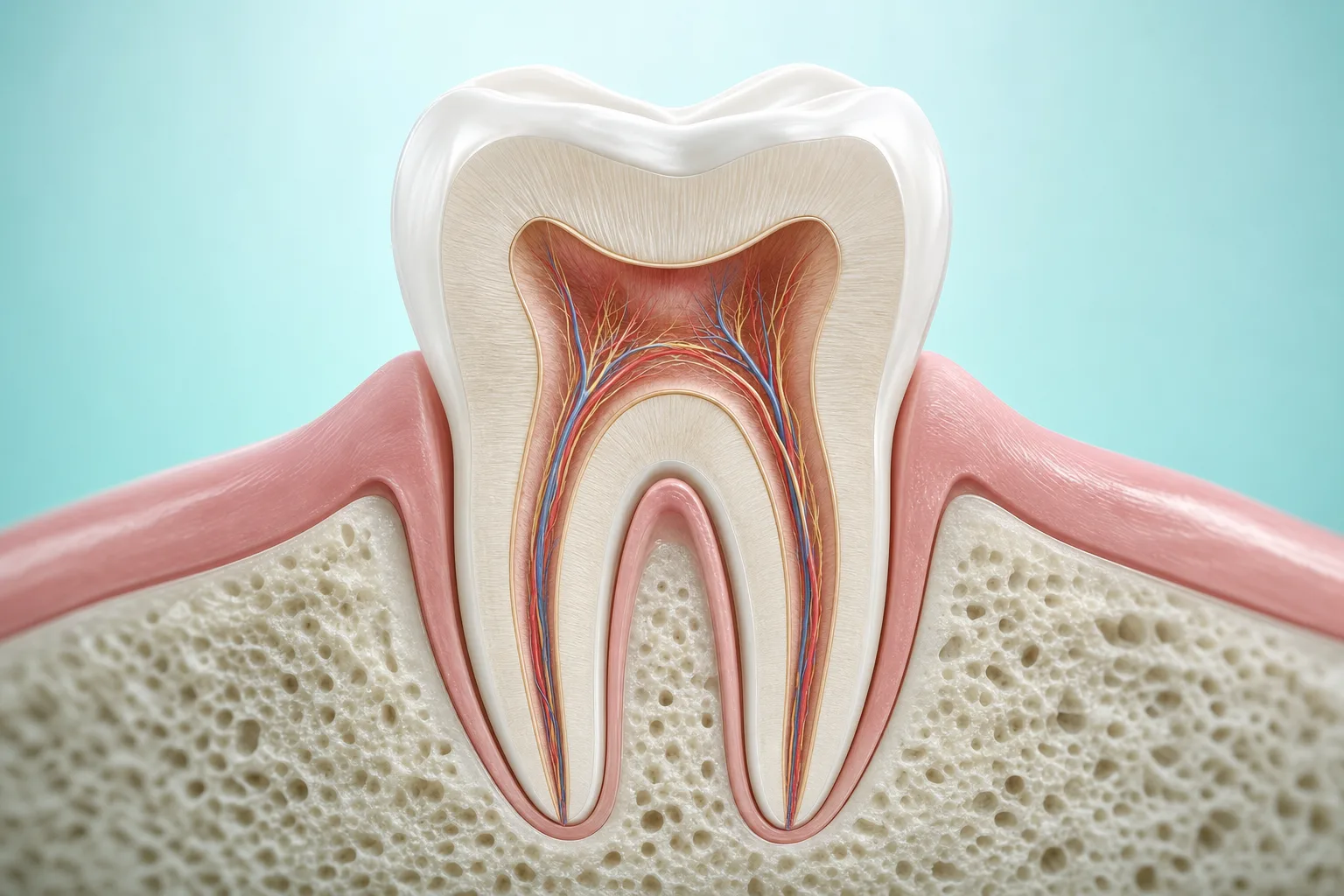
Nearly every toothache decision comes down to one question: can this nerve recover if we remove what is irritating it? The pulp lives sealed inside rigid dentin with a blood supply entering through a pinhole at the root tip. It has almost no room to swell. Once inflammation passes a certain point, the swelling itself strangles the blood supply, and the tissue cannot come back.
| Reversible pulpitis | Irreversible pulpitis | |
|---|---|---|
| What triggers it | Cold, sweet, sometimes air | Cold at first, then heat; eventually nothing at all |
| How long pain lasts | 1–2 seconds, occasionally up to ten | 30 seconds to hours, and it may build after the trigger is gone |
| Pain with no trigger | No | Yes — this is the hallmark |
| Wakes you at night | Rarely | Commonly |
| Can you point to the tooth | Usually yes | Often no; the pain radiates along the jaw or up toward the ear |
| Usual treatment | Remove the cause: filling, desensitizer, adjusting a high bite | Root canal treatment, or removing the tooth |
| Left alone | Often settles once the irritant is fixed | Progresses to nerve death, then infection in the bone |
Why does my tooth hurt more at night?
Patients describe this constantly and often assume it is imagination or stress. It is neither. When you lie flat, blood pressure in the veins of your head rises. In most tissue that goes unnoticed, because the tissue expands slightly to absorb it. The pulp cannot expand. It is enclosed in a chamber with walls that do not move, so any increase in pressure presses directly on nerve fibers that are already inflamed.
Two ordinary factors stack on top of the physiology. There is nothing to distract you at 2 a.m., and the anti-inflammatory you took with dinner has worn off by then.
Practically: sleep propped up on two or three pillows, or in a recliner if you have one. Time your last dose so it covers the early hours rather than the evening. And note whether sitting up genuinely helps — if it does, that is a useful piece of diagnostic information to bring with you, because it points at pressure inside the tooth rather than at a strained jaw muscle.
Hot drinks hurt but cold water helps — why that reversal is the one to act on
Some people arrive at an appointment holding a bottle of ice water, sipping it constantly. That detail alone tells a dentist a great deal.
When pulp tissue dies, it breaks down, and the breakdown produces gas inside a sealed chamber. Heat expands gas. Cold contracts it. So a hot coffee spikes the internal pressure and produces a sharp, sickening pain, while cold water shrinks the gas volume and brings genuine relief for as long as it lasts. It is a mechanical effect, and it is one of the more specific signs in dentistry that a nerve has died and an abscess is forming at the root.
This is the one pattern where waiting to see how it goes is the wrong call. It does not indicate irritation that might calm down; it indicates tissue that is already necrotic. And there is a trap on the other side: once the nerve finishes dying, the pain often disappears completely for days or weeks. That silence is not recovery. The infection continues quietly in the bone, and the next thing that usually happens is swelling.
Pain when you bite down — or the instant you let go
These are two different findings and the difference matters.
Pain while biting, on a tooth that also feels tender to tapping and slightly taller than its neighbors, usually means inflammation in the ligament around the root. If it started within days of a new filling or crown, the cause is often a restoration sitting a fraction of a millimetre high, which is adjusted in a few minutes. If there was no recent dental work, the more likely source is infection spreading out of the root tip.
Pain the split second you release is the classic cracked-tooth sign. Clenching down closes the crack; letting go lets the segments spring apart, fluid shifts inside the dentin tubules, and the nerve reports it as a sharp, brief jolt. It is usually reproducible on one specific cusp and one specific angle of chewing.
Worth knowing before your appointment: hairline cracks often do not appear on an X-ray at all. A fracture plane running front-to-back is essentially invisible to a beam traveling the same direction, so a clean radiograph does not rule a crack out. Diagnosis comes from a bite stick, transillumination, sometimes a dye — and from what you report. Our deeper piece on pain that appears when you chew covers the full workup.
When the tooth is not the problem
A good share of toothaches are not coming from the tooth being blamed.
- Sinus pressure. The roots of the upper molars sit against the floor of the maxillary sinus. Inflammation there aches through several upper teeth at once, worsens when you bend forward or go down stairs, and is usually bilateral. One tooth, one side, sharp to cold is dental. Several teeth, dull, with a stuffy head is often not — we sort the two apart in our guide to allergy-season tooth pain. The rule that settles most cases: pain that outlasts the congestion is dental.
- Clenching and grinding. Teeth that all ache on waking, a jaw that feels fatigued, temples that are sore — that is muscle and ligament, not decay. A custom night guard addresses the load; nothing else will while the grinding continues.
- Gums rather than teeth. A dull, pressure-like ache between two teeth with gums that bleed when you floss is usually inflammation or trapped food, and sometimes the early stage of periodontal disease. Recession also exposes root surface, which has no enamel over it and is far more cold-sensitive than crown enamel — the same reason cold drinks set some teeth off and not others.
- A wisdom tooth partially through the gum. Pain behind the last molar with a swollen, tender flap of gum over it, often with a bad taste, is the tissue infected around a tooth that is only half erupted.
- The wrong tooth entirely. Pulp tissue has no ability to locate itself in space. Patients regularly point confidently at an upper tooth when the problem is the lower one directly beneath it. Do not be surprised if testing lands somewhere other than where you feel it.
What actually helps between now and your appointment
The American Dental Association's guidance on managing acute dental pain places non-steroidal anti-inflammatories first for healthy adults — ibuprofen and its relatives — alone or paired with acetaminophen, which studies consistently find outperforms opioids for pain of dental origin. Practically, that means an over-the-counter dose of ibuprofen, taken on schedule rather than only when the pain peaks, with acetaminophen added between doses if it is not enough. Stay inside package directions, and check with your physician or pharmacist first if you are pregnant, on blood thinners, or have kidney, stomach or liver issues.
A few other things that genuinely help: sleeping propped up, a cold compress on the outside of the cheek in 15-minute stretches, rinsing with warm salt water after meals, and chewing entirely on the other side.
Things that do not, and some that cause harm:
- Aspirin held against the gum. It does nothing for the tooth and produces a chemical burn on the tissue — a white, sloughing patch that then hurts on its own.
- Clove oil packed into the tooth. Eugenol numbs briefly. It does not reach an infected nerve, and undiluted oil irritates the gum and tongue.
- Heat on a swollen face. Cold, not heat. Warmth increases blood flow into an area you want to keep contained.
- Leftover antibiotics from an old prescription. The 2019 ADA clinical guidance is direct on this point: for a healthy adult with irreversible pulpitis or a localized dental abscess, antibiotics alone are not the treatment. Draining the source or treating the tooth is. Antibiotics may quiet the swelling for a week; the tooth is exactly where you left it.
Get seen urgently if… your face or neck is swelling, especially if the swelling is closing an eye, crossing under the chin, or pushing the floor of your mouth up. Go to an emergency room now — not tomorrow — if you have difficulty swallowing or breathing, cannot open your mouth more than a finger or two, are running a fever, or feel generally unwell alongside the dental pain. Those signs mean infection is spreading through tissue spaces rather than staying at the root. Bleeding you cannot stop, or a tooth knocked out of its socket, also needs care immediately.
What happens if you wait it out
Toothaches do go quiet. That is the trap, and it is why the same conversation happens in dental offices every week.
The sequence is fairly predictable. Decay reaches the pulp and the tooth becomes sensitive. Inflammation passes the point of recovery and the pain turns spontaneous and keeps you up. The nerve dies and the pain stops, which feels like healing. Bacteria then move down the canals into the bone at the root tip, and weeks or months later you get pressure, tenderness to chewing, a gum boil, or a swollen face.
The treatment ladder climbs alongside it. A tooth that needed a filling in March may need root canal treatment and a crown by August, and if a cusp fractures below the gumline in the meantime, the conversation shifts to removing it and deciding how to fill the space. Each step is longer, costs more, and gives back less. That is the honest argument for calling early — not fear, arithmetic.
Cost is a real reason people delay, so it is worth saying plainly that we accept most PPO and HMO plans as well as Denti-Cal and Medi-Cal, and that CareCredit, Cherry and Sunbit are available for what a plan does not cover. Ask about it when you call rather than waiting until the tooth forces the issue.
What to tell us when you call
Five details shorten the diagnosis considerably, and most people have never been asked for them:
- How long the pain lasts after cold, timed in seconds.
- Whether it ever starts with nothing touching the tooth.
- Whether heat makes it worse and cold makes it better.
- Whether it hurts on biting down, on letting go, or both.
- Whether it wakes you, and whether sitting up changes it.
Write them on your phone before the appointment. Pain has a way of vanishing in the waiting room, and what you remember about the pattern is often more diagnostic than what the tooth is doing at the moment we look at it.
If a tooth is keeping you up
Dr. Sameer Aljanedi and our bilingual team see toothaches every day at our Paramount Boulevard office, and the pattern you describe usually tells us most of what we need before we pick up an instrument. Se habla español. Book a visit or call (562) 928-5559 — and if your face is swelling, call first rather than waiting for a form to go through.
Have questions about your smile?
Dr. Sameer Aljanedi and the team at Rio Hondo Dental Office are here to help. Se habla español.